What Are the Most Extraordinary Rock-Cut Temples and Monuments in the Ancient World?
June 30, 2026 · 6 min read
The Greatest Rock-Cut Monuments of the Ancient World
The most extraordinary rock-cut monuments in the ancient world include the Treasury at Petra in Jordan, the Kailasa Temple at Ellora in India, the Lycian cliff tombs of Turkey, and the enigmatic carved doorway of Hayu Marca in Peru — structures built not by stacking stone, but by removing it, revealing architecture that has outlasted virtually every other trace of the civilisations that created it.
Petra: A Rose-Red City Hidden in a Desert Canyon
Deep in the desert gorges of southern Jordan, the ancient Nabataean people carved a city of extraordinary scale and beauty from rose-red sandstone. At its heart stands Al-Khazneh — the Treasury — a facade roughly forty metres tall, equivalent to a thirteen-storey building, cut entirely by hand from a single canyon wall. At its peak, Petra housed an estimated twenty thousand to thirty thousand inhabitants, making it one of the ancient world’s most populated desert capitals.
What makes Petra more than a visual spectacle is the engineering hidden beneath it. Archaeologists have uncovered evidence of over two hundred kilometres of ceramic pipe channels, dams, and cisterns threading through the rock and sand around the city — a water infrastructure system that sustained a thriving metropolis in one of the most arid environments on Earth. The Nabataeans were not decorators. They were masters of desert survival at civic scale.
Petra then vanished from Western knowledge almost entirely. For roughly five centuries, no European knew it existed. It was rediscovered in 1812 when Swiss explorer Johann Ludwig Burckhardt disguised himself as a Muslim pilgrim and followed local guides through the narrow gorge known as the Siq. When he emerged and looked up at the Treasury, he was the first European to see it since the Crusades.
The Kailasa Temple at Ellora: Carved Downward Through a Mountain
In Maharashtra, India, the Kailasa Temple at the Ellora Caves holds a distinction no other structure on Earth can claim: it is the largest monolithic rock-cut temple in the world. Unlike conventional temples, which rise upward from foundations, the Kailasa was built by working downward — builders began at the summit of a basalt cliff and carved away everything that was not the temple, leaving the structure standing inside the mountain.
Estimates suggest between two hundred thousand and four hundred thousand tonnes of rock were removed in the process, all chiselled out by hand and carried away. The scale of that excavation is almost impossible to internalise. But the detail that stops engineers cold is the irreversibility of every decision: there was no patching errors, no going back. Every strike of the chisel was permanent.
Commissioned by the Rashtrakuta king Krishna I around 756 CE, the temple’s interior walls are covered in elaborate carvings of gods, mythological narratives, and celestial figures — all worked from the same continuous body of stone. The Kailasa Temple is not a building placed on rock. It is a building that was always inside the rock. The builders, as its creators may have understood it, simply revealed what was already there.
The Lycian Rock-Cut Tombs: Houses for the Departed in the Sky
On the rugged southwestern coast of what is now Turkey, the ancient Lycians held a belief that shaped their approach to burial entirely: they believed the departed were carried skyward by winged creatures. To honour that journey, they carved the resting places of their dead as high on the cliff face as it was physically possible to reach.
At the ancient city of Myra — modern Demre — hundreds of tombs are cut directly into vertical cliff faces across two separate necropoleis. These are not simple hollows. They are architectural reproductions, carved to mimic the wooden facades of Lycian domestic homes, complete with rendered beams, rafters, and door frames — all executed in stone, hundreds of feet above the valley floor. The intention was that the departed would recognise their surroundings and feel at home.
Dating primarily to the fourth century BCE, the Lycian tombs carry an unexpected legacy: because almost no actual Lycian wooden architecture survived, archaeologists were able to use the stone tomb carvings to reconstruct what Lycian homes once looked like. The copies outlasted the originals. The tombs became the primary evidence for an entire tradition of domestic building.
Hayu Marca: The Doorway That Goes Nowhere
In the Puno region of Peru, near the shore of Lake Titicaca at an altitude of approximately 3,800 metres above sea level, a carved rock face known as Hayu Marca contains one of the most debated structures in South American archaeology. It is a doorway: approximately seven metres tall, seven metres wide, cut from the surrounding stone with striking precision and symmetry. Carved into its centre, at floor level, is a smaller T-shaped niche roughly two metres in height.
There is no tunnel behind it. No room. No passage. Just the frame, standing alone in the high plateau. No city surrounds it. No temple. No burial site. Just the doorway and the silence of the altiplano.
Researchers have proposed that the niche functioned as a ritual alcove, or that the structure served as a symbolic threshold — a carved representation of a boundary between states of existence. Ground-penetrating radar and satellite imaging have been applied to the site. The debate continues. No explanation has achieved consensus. The door remains, perfectly carved, pointing at something that has not yet been identified.
What These Four Sites Share Across Continents and Centuries
Petra, Ellora, Myra, and Hayu Marca were created by civilisations that had no contact with one another, separated by thousands of miles and in some cases thousands of years. Yet all four arrived at the same fundamental approach: the mountain is not the obstacle. The mountain is the material.
In each case, working directly into living rock produced monuments of extraordinary durability. You cannot demolish what was never constructed from separate pieces. The rock-cut structures have survived long after every other trace of the cultures that made them — the wooden buildings, the textiles, the perishable records — has disappeared. In Lycia, the stone tombs became the only surviving evidence of how people actually lived. The architecture of the dead preserved the memory of the living.
The Hayu Marca doorway remains the most unresolved of these four sites — and in some ways the most honest summary of where ancient archaeology stands. Even with modern technology and centuries of accumulated scholarship, a perfectly carved doorway at nearly four thousand metres above sea level still has not given up its purpose. The ancient world carved its intentions into mountains, and the mountains have kept some of those intentions close.
What these sites collectively demonstrate is that the ancient world was more ambitious, more technically sophisticated, and in several cases more mysterious than most conventional history accounts suggest. The rock does not lie — but it does not always explain itself either.
FREQUENTLY ASKED
Who built the Treasury at Petra and when? ▾
The Treasury at Petra was built by the Nabataean people, a sophisticated Arabian trading civilisation that established Petra as their capital. The structure is believed to date to the first century BCE, during the reign of the Nabataean king Aretas IV.
How much rock was removed to build the Kailasa Temple at Ellora? ▾
Estimates suggest between 200,000 and 400,000 tonnes of basalt rock were removed by hand to carve the Kailasa Temple from the mountain at Ellora. The temple was commissioned around 756 CE by the Rashtrakuta king Krishna I.
Why did the ancient Lycians carve tombs into cliff faces? ▾
The Lycians believed the dead were carried skyward by winged creatures, so they positioned burial tombs as high on cliff faces as possible to honour that journey. The tombs were also carved to resemble the facades of domestic homes so the departed would feel familiar with their surroundings.
What is Hayu Marca in Peru and why is it mysterious? ▾
Hayu Marca is a carved rock face near Lake Titicaca in Peru featuring a precisely cut doorway approximately seven metres tall with a smaller niche at its base, but no tunnel, room, or passage behind it. No agreed archaeological explanation for its purpose has been established.
How was Petra lost to Western knowledge for so long? ▾
Following the decline of Nabataean and later Byzantine and Crusader-era use of the region, Petra became known only to local Bedouin tribes and was effectively unknown to Western scholarship for roughly five centuries. It was reintroduced to European knowledge in 1812 by Swiss explorer Johann Ludwig Burckhardt.
What is the largest monolithic rock-cut structure in the world? ▾
The Kailasa Temple at the Ellora Caves in Maharashtra, India, is considered the largest monolithic rock-cut structure ever created, carved from a single continuous body of basalt rock. Unlike conventional buildings, it was constructed by carving downward into a cliff rather than building upward from a foundation.
GO DEEPER
KEEP EXPLORING
 0:42
0:42They Paved a Roman Road With a 7ft Ancient Statue 🏛️
Oct 6, 2026 0:49
0:49This Iron Pillar Refused To Rust For 1,600 Years ⚙️
Oct 5, 2026 0:52
0:52A 160-Ton Obelisk Flew Home After 68 Years ✈️
Oct 4, 2026 0:19
0:19They Built A 41ft Ring From 60 Mammoths 🦣
Oct 3, 2026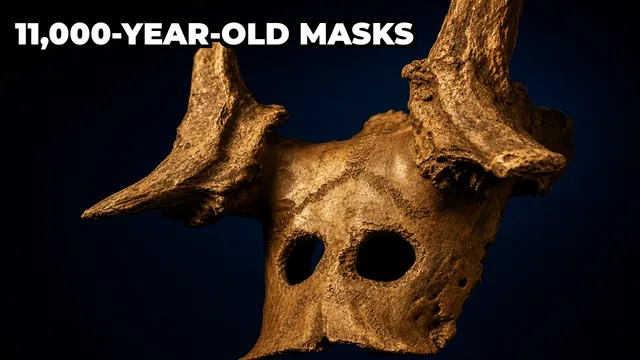 0:05
0:0533 Deer Skull Masks — 11,000 Years Old 🦌😱
Oct 2, 2026 0:34
0:34