What Are the Most Dangerous Zones in the Ocean That Scientists Can't Fully Explain?
April 18, 2026 · 5 min read
The most dangerous zones in the ocean include methane crater fields, brine pools, the SOFAR Channel, massive internal waves, and expanding dead zones—phenomena that combine lethal conditions with scientific mysteries that researchers are still working to understand. These areas represent some of the most hostile environments on Earth, where normal physics seem to break down and life-threatening conditions exist in ways that challenge our understanding of marine science.
The ocean covers 71% of our planet, yet we’ve explored less than 20% of it. What lies in the unexplored depths isn’t just unknown—it’s actively dangerous to human life in ways that defy conventional scientific explanation.
Methane Craters: Underwater Time Bombs
Beneath the ocean floor, particularly in the Arctic and North Sea regions, lie massive craters blasted open by ancient methane explosions. Researchers from the University of Southampton have discovered craters up to half a mile wide near the Bermuda Triangle area, while Norwegian Sea craters stretch nearly a kilometer across—and some formed within just the last 12,000 years.
When methane erupts from the seafloor in massive quantities, it reduces water density so dramatically that ships can lose buoyancy and sink within seconds, leaving no time for distress calls. The terrifying reality is that many of these crater systems remain active, and a large-scale methane release could trigger irreversible climate feedback loops.
Underwater Rivers and Lakes That Shouldn’t Exist
Deep beneath the ocean’s surface flow actual rivers—complete with banks, currents, and even waterfalls. The Black Sea Channel represents one such phenomenon: a river of dense, salty water flowing across the seafloor for over 60 kilometers, carrying sediment and debris like any surface river.
Even more bizarre are brine pools in the Gulf of Mexico—underwater lakes five times saltier than regular seawater. These pools maintain distinct shorelines at the ocean bottom, with waves lapping at their edges. Fish that swim into them die instantly from salinity shock, yet strange organisms like tube worms and extremophile bacteria thrive at the deadly transition zones.
The SOFAR Channel: Sound Trap of the Deep
At approximately 1,000 meters below the surface exists a natural acoustic prison called the SOFAR Channel (Sound Fixing and Ranging). Here, temperature and pressure conditions create a waveguide that traps sound waves, preventing them from escaping upward or downward. Explosions in this channel have been detected over 3,500 miles away.
The U.S. Navy discovered and utilized this phenomenon during the Cold War for submarine tracking, and much of what they recorded remains classified. Before industrial noise pollution, blue whales used the SOFAR Channel to communicate across entire ocean basins, creating a planetary communication network that we’ve been inadvertently jamming for decades.
Internal Waves: The Ocean’s Invisible Giants
Perhaps the most terrifying phenomena are internal waves—massive disturbances that move deep within the water column, invisible from the surface. In the South China Sea, researchers have measured internal waves over 500 meters tall (nearly a third of a mile) moving at speeds up to 8 knots.
These underwater giants can snap submarine cables and capsize vessels from below without warning. In 2003, a U.S. Navy research ship reported being physically pushed sideways by an internal wave. Their unpredictable interactions with underwater geography make them a hidden variable in every deep ocean operation.
Dead Zones: Expanding Regions of Nothing
Over 400 ocean dead zones now exist worldwide—regions where oxygen has been completely stripped from the water by algae blooms and chemical runoff. Nothing survives in these areas: no fish, no crabs, not even microbes. The Gulf of Mexico dead zone covers an area the size of New Jersey every summer, and the number of these lifeless regions has doubled every decade since the 1960s.
Hydrothermal Vents: Life in Hell
Black smokers—hydrothermal vents discovered in 1977—shoot superheated water at over 400°C into the freezing abyss. These volcanic chimneys create the most acidic, metal-saturated water on Earth, so corrosive that early research equipment returned chemically scarred. Yet they support entire ecosystems of creatures that exist nowhere else, powered by chemical energy from Earth’s core rather than sunlight.
Point Nemo: The Loneliest Place on Earth
In the South Pacific sits Point Nemo, 2,688 kilometers from the nearest land in any direction. This oceanic pole of inaccessibility is so remote that astronauts aboard the International Space Station are often the closest humans to it. The waters here are so nutrient-poor they form a biological desert, leading space agencies to use the area as a spacecraft graveyard for over 260 derelict vehicles.
The Pattern Behind the Chaos
What connects all these dangerous zones is that the ocean isn’t passive—it’s an active, dynamic system that governs weather, climate, and oxygen supply in ways we’re only beginning to understand. We’ve mapped more of Mars than our own ocean floor, and in the 80% we haven’t explored, these forces continue operating beyond our observation.
Each discovery reveals that our planet’s dominant feature operates by rules that challenge textbook physics, creating environments that seem more alien than terrestrial. The ocean remains Earth’s final frontier, and the deeper we look, the stranger and more dangerous it becomes.
FREQUENTLY ASKED
What is the most dangerous part of the ocean? ▾
The Drake Passage between South America and Antarctica is considered the most dangerous stretch of open water, where three oceans collide with no landmass to slow them down, creating waves regularly exceeding 20 meters.
How much of the ocean have we actually explored? ▾
Scientists estimate we've explored less than 20% of the ocean, meaning over 80% remains unmapped and unstudied, potentially hiding phenomena we can't yet imagine.
What causes ocean dead zones to form? ▾
Dead zones form when algae blooms and chemical runoff consume all available oxygen in the water, creating areas where no marine life can survive.
Can ships really sink from methane bubbles in the ocean? ▾
Yes, when methane erupts from the seafloor in massive quantities, it reduces water density so dramatically that ships can lose buoyancy and sink within seconds. This occurs because the methane-saturated water cannot provide enough support for vessels to remain afloat.
What are underwater rivers and how do they exist? ▾
Underwater rivers are flows of dense, salty water that move across the seafloor with distinct banks and currents, like the Black Sea Channel which flows for over 60 kilometers. These form when differences in water density create separate layers that behave like surface rivers flowing along the ocean bottom.
How tall can internal waves get in the ocean? ▾
Internal waves can reach heights of over 500 meters (nearly a third of a mile), with some in the South China Sea moving at speeds up to 8 knots. These massive underwater disturbances are invisible from the surface but can physically push ships sideways and snap submarine cables.
GO DEEPER
KEEP EXPLORING
 0:05
0:05He Sailed 4,300 Miles on Logs — Then Science Said No 🪵
Oct 21, 2026 0:21
0:21Where Space Stations Go to Rest 🌊 (1,670 Miles From Land)
Oct 20, 2026 0:38
0:38The Vampire Squid Escapes in a Cloud of Light 🦑
Oct 19, 2026 0:08
0:08The Bermuda Triangle Mystery Was Never Real 🌊
Oct 18, 2026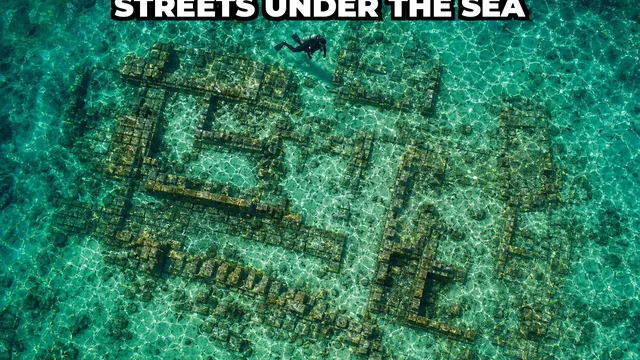 0:01
0:01This 5,000-Year-Old Town Still Has Streets Under the Sea 🌊
Oct 17, 2026 0:45
0:45