An estimated 76% of deep-sea animals produce their own light through bioluminescence, using it to hunt, hide, communicate, and survive in the ocean’s permanent darkness. This biological light production evolved independently dozens of times across unrelated species as a solution to life in the lightless depths.
The Science Behind Deep Sea Bioluminescence
Bioluminescence in deep-sea creatures occurs through chemical reactions involving luciferin (a light-producing compound) and the enzyme luciferase. When these substances combine with oxygen, they produce light with minimal heat waste—making it far more efficient than any artificial light source humans have created.
The deep ocean, defined as waters below 200 meters where sunlight cannot penetrate, represents Earth’s largest habitat. In this perpetual darkness, the ability to produce light became such a crucial survival advantage that it evolved independently across dozens of unrelated animal lineages over hundreds of millions of years.
Eight Remarkable Examples of Deep Sea Luminescence
The Anglerfish’s Borrowed Light
The anglerfish demonstrates one of nature’s most sophisticated examples of symbiosis. The glowing lure dangling in front of its massive jaws isn’t powered by the fish itself—it’s illuminated by symbiotic bacteria living inside a specialized organ called the esca. These microorganisms produce light in exchange for nutrients and shelter, creating a deadly beacon that attracts unsuspecting prey directly into the anglerfish’s teeth.
Firefly Squids and Japan’s Electric Bay
Every spring, millions of firefly squids (Watasenia scintillans) gather in Toyama Bay, Japan, creating one of nature’s most spectacular light shows. These small squid possess thousands of photophores—specialized light-producing organs—that pulse in synchronized waves of brilliant blue light. Remarkably, firefly squids are among the only cephalopods with color vision, possessing three distinct types of photoreceptors that allow them to see in color even in near-total darkness.
Lanternfish: The Ocean’s Hidden Migration
Lanternfish (family Myctophidae) comprise up to 65% of all deep-sea fish biomass and participate in the largest daily animal migration on Earth. Every night, they rise from depths of 300-1000 meters to feed at the surface, then descend again at dawn. This massive vertical movement plays a crucial role in ocean ecology by transporting carbon from surface waters to the deep sea—a process known as the biological carbon pump.
The Dragonfish’s Secret Weapon
The dragonfish (Aristostomias scintillans) evolved perhaps the most cunning use of bioluminescence: it produces red light that most deep-sea creatures cannot see. While other deep-sea animals evolved in blue-green wavelengths, the dragonfish developed both red bioluminescence and the ability to detect it. This gives it a private searchlight to illuminate prey while remaining invisible to them—nature’s version of night-vision technology.
Counter-Illumination: The Ultimate Camouflage
Marine hatchetfish have perfected one of the most sophisticated camouflage techniques in nature. They use photophores along their belly to match the faint downwelling light from above, effectively erasing their shadow when viewed from below. This counter-illumination requires constant adjustment as light levels change, representing a real-time biological solution to a complex physics problem that human engineers struggle to replicate.
Ancient Origins and Independent Evolution
Comb jellies provide evidence that bioluminescence has ancient origins, with fossil records dating their luminescent displays back at least 520 million years to the Cambrian period. These creatures were producing light long before fish existed, highlighting how fundamental this ability became to deep-sea survival.
The fact that bioluminescence evolved independently in jellyfish, squid, fish, bacteria, and dozens of other unrelated groups demonstrates the overwhelming evolutionary pressure to produce light in the deep ocean. Rather than being an unusual adaptation, glowing became the norm—creatures that don’t produce light are actually the minority in deep-sea environments.
Ecological Impact and Abundance
The sheer numbers of bioluminescent deep-sea creatures are staggering. Bristlemouth fish (genus Cyclothone) are estimated to number in the hundreds of trillions, making them possibly the most abundant vertebrate on Earth. Despite their incredible numbers, most humans will never see these small, glowing fish that live in the mesopelagic zone.
These bioluminescent creatures form the foundation of deep-sea food webs and play crucial roles in global ocean processes. Their daily migrations help distribute nutrients and carbon throughout the ocean depths, influencing everything from climate regulation to surface productivity.
The deep ocean remains largely unexplored, with scientists estimating that we’ve formally described less than a fraction of the species living in these depths. As exploration technology advances, researchers continue to discover new bioluminescent species, each with unique adaptations for life in Earth’s largest and most mysterious habitat.
FREQUENTLY ASKED
What percentage of deep sea animals can produce their own light? ▾
Scientists estimate that approximately 76% of all deep-sea animals produce their own light through bioluminescence, making glowing creatures the majority rather than the exception in deep ocean environments.
How deep do you have to go before sea creatures start glowing? ▾
Bioluminescent creatures begin appearing around 200 meters deep, where sunlight can no longer penetrate and the ocean enters permanent darkness.
What chemicals make deep sea creatures glow? ▾
Deep-sea bioluminescence is produced by chemical reactions between luciferin (a light-producing compound) and the enzyme luciferase in the presence of oxygen.
Do deep sea creatures glow different colors? ▾
Most deep-sea bioluminescence appears blue or blue-green, though some species like the dragonfish can produce red light that most other deep-sea creatures cannot see.
Why don't deep sea creatures use regular eyesight instead of glowing? ▾
Below 200 meters, no sunlight penetrates the ocean, creating permanent darkness where traditional eyesight becomes useless without a light source.
Which deep sea creature has the most impressive light display? ▾
Firefly squids create one of the most spectacular displays, gathering in millions to turn entire bays electric blue during their spawning season in Japan.
GO DEEPER
KEEP EXPLORING
 0:42
0:42The 84ft Wave That Ended 200 Years Of Doubt 🌊
Oct 24, 2026 0:05
0:05He Sailed 4,300 Miles on Logs — Then Science Said No 🪵
Oct 21, 2026 0:21
0:21Where Space Stations Go to Rest 🌊 (1,670 Miles From Land)
Oct 20, 2026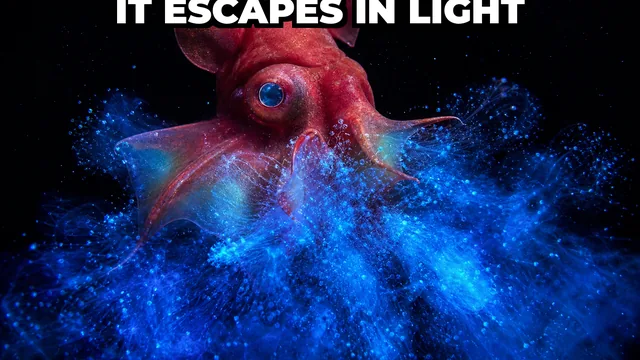 0:38
0:38The Vampire Squid Escapes in a Cloud of Light 🦑
Oct 19, 2026 0:08
0:08The Bermuda Triangle Mystery Was Never Real 🌊
Oct 18, 2026 0:01
0:01