What Are the Deepest Holes on Earth That No One Has Ever Reached the Bottom Of?
August 1, 2026 · 6 min read
The Deepest Holes on Earth
The deepest holes on Earth include natural sinkholes, flooded cave systems, and man-made boreholes so extreme that explorers, robots, and drilling rigs have all been forced to turn back before reaching the bottom — with the Kola Superdeep Borehole holding the artificial record at 12,262 meters, and El Zacatón holding the record for the deepest known water-filled sinkhole at 339 meters.
El Zacatón: The Flooded Pit That Defeated a World Record Diver
In April 1994, elite cave diver Jim Bowden descended into El Zacatón — a perfectly circular, sulphur-tinged sinkhole in Tamaulipas, Mexico — and reached 282 meters (925 feet), setting a men’s world depth record. When he looked down, there was nothing but blackness. His gas supply ran out before the abyss did, and he was forced to turn back without ever seeing the floor.
El Zacatón is the deepest known water-filled sinkhole on Earth, plunging to at least 318–339 meters below the water surface. To put that in perspective, you could stack the Eiffel Tower three times over and it would disappear beneath the surface. For decades, no human being could confirm what lay at the bottom — or even estimate how far down the bottom truly was.
That changed in 2007, when NASA funded a robotic submarine called DEPTHX (Deep Phreatic Thermal Explorer), developed by Stone Aerospace and Carnegie Mellon University. It was the first fully autonomous underwater robot designed to map a three-dimensional submerged environment. When DEPTHX was sent into El Zacatón, it accomplished what no human being had: it reached the true bottom and mapped the entire interior — a vast, cathedral-like submerged shaft with overhangs, ledges, and hidden chambers. Jim Bowden’s extraordinary 925-foot world record dive had not even gotten a human being halfway to understanding what El Zacatón actually was.
The Kola Superdeep Borehole: When the Earth Fought Back
In the frozen wilderness of Russia’s Kola Peninsula, a rusted metal disc bolted into the ground is the only visible sign of one of humanity’s greatest and most humbling engineering achievements. Beneath it lies the Kola Superdeep Borehole — the deepest artificial point ever drilled into the Earth, reaching 12,262 meters (40,230 feet) straight down.
Soviet scientists began drilling in 1970 and spent over two decades pushing deeper into the planet’s crust. Their models predicted temperatures of around 100°C at 12 kilometers depth — hot, but theoretically manageable. What they actually encountered was 180°C. At that depth, the rock had become almost plastic, sealing around drill bits and deforming equipment in ways that defied every prediction. Drilling was permanently abandoned. The hole has been sealed ever since.
The Kola Borehole is not just the deepest hole ever made — it is a monument to how wrong humanity’s models of the deep Earth were. Everything scientists thought they knew about subsurface temperature gradients had to be revised. The planet stopped the drill not with a cave-in or an earthquake, but with heat that no technology at the time could overcome.
China’s Heavenly Pits: Sinkholes Hiding Ancient Forests
The Xiaozhai Tiankeng in Chongqing, China — whose name translates to ‘heavenly pit’ — is the largest known collapse sinkhole on Earth. It measures 662 meters deep and 537 meters wide. At the bottom, completely isolated from the surface by hundreds of meters of vertical rock, sits an enclosed river gorge with its own distinct ecosystem. Species found at the floor are uniquely adapted to that specific micro-environment and may include organisms not yet formally described by science.
In May 2022, a caving expedition in Leye County, Guangxi, discovered a newly identified tiankeng — and when explorers reached the bottom, they found something no scientist had documented there: a pristine forest growing 192 meters below the surface, with trees tall enough to reach toward the circle of light far above. The forest was completely intact, untouched, and home to species thriving in total isolation from the world above. The expedition had stumbled into it by accident.
Antarctica’s Ice Boreholes: 2,500 Meters Into Ancient Ice
At the South Pole, scientists from the IceCube Neutrino Observatory drilled 86 holes into the Antarctic ice sheet, each reaching 2,500 meters deep — approximately 8,200 feet of ice that fell as snow hundreds of thousands of years ago. The goal was not exploration in any conventional sense: each shaft served as a channel for detector strings designed to catch neutrinos — near-massless ghost particles produced by exploded stars — using the entire Antarctic ice sheet as a detection medium.
Each hole was only the width of a dinner plate. Each refroze around its detectors almost immediately after installation, sealing the instruments in place permanently. Those boreholes will never be reopened. They represent one of the largest and deepest intentional shaft arrays ever created by human beings — built not to explore, but to listen to the universe.
Veryovkina Cave: The Deepest Confirmed Cave System on Earth
In the Republic of Abkhazia, the Veryovkina Cave descends 2,212 meters (7,257 feet) below the surface, making it one of the deepest confirmed cave systems ever measured. Reaching its lower passages requires weeks of underground travel through freezing water, vertical rope drops in total darkness, and passages so narrow that cavers must remove their packs and squeeze through on their own. At its deepest explored sections, there are still branching tunnels that no one has followed to their end.
The Deepest Hand-Dug Well in Human History
Not every unconquerable pit is a product of geology or Soviet engineering ambition. Between 1858 and 1862, Victorian laborers in Woodingdean, Brighton, England, dug the world’s deepest hand-excavated well using nothing but picks, buckets, and human labor — no power tools, no modern equipment. When they finally struck water, they had gone 390 meters (1,285 feet) straight down. Workers at the surface could not see the bottom of their own excavation. It remains the deepest hand-dug shaft in recorded history.
What These Holes Tell Us About Our Planet
What unites El Zacatón, the Kola Borehole, Xiaozhai Tiankeng, the Leye County forest sinkhole, Antarctica’s ice shafts, Veryovkina Cave, and the Woodingdean Well is a single, humbling truth: the Earth does not give up its depths easily. Some of these places swallowed world records. Some stopped the most advanced drilling technology ever built. Some hid forests and undescribed species for millennia. And some have still not surrendered their secrets at all. We live on a planet that is, in the most literal sense, still unfathomable — and the deepest vertical shafts on Earth are proof that the age of discovery is far from over.
FREQUENTLY ASKED
What is the deepest water-filled sinkhole on Earth? ▾
El Zacatón in Tamaulipas, Mexico, is the deepest known water-filled sinkhole on Earth, reaching at least 318–339 meters below the water surface. Its true depth was only confirmed in 2007 by a NASA-funded autonomous robot called DEPTHX.
How deep is the Kola Superdeep Borehole and why did they stop drilling? ▾
The Kola Superdeep Borehole reaches 12,262 meters (40,230 feet) and drilling was abandoned because temperatures at depth reached 180°C — nearly double what scientists had predicted — making the rock too plastic and the equipment impossible to operate.
Has anyone ever found a forest inside a sinkhole? ▾
Yes — in May 2022, a caving expedition in Leye County, Guangxi, China, discovered a pristine ancient forest growing 192 meters below the surface inside a previously unmapped tiankeng, or collapse sinkhole. The forest contained trees tall enough to reach toward the light opening above.
What is the deepest cave system in the world? ▾
Veryovkina Cave in the Republic of Abkhazia is one of the deepest confirmed cave systems on Earth, descending 2,212 meters (7,257 feet). Explorers have reached its lower sections but still have not followed all branching tunnels to their ends.
What did the DEPTHX robot discover in El Zacatón? ▾
DEPTHX, a fully autonomous underwater robot funded by NASA, became the first machine or human to reach the true bottom of El Zacatón in 2007, mapping a vast cathedral-like submerged shaft with overhangs, ledges, and hidden chambers at 318–339 meters depth.
What is the deepest hand-dug well ever constructed? ▾
The Woodingdean Well in Brighton, England, dug between 1858 and 1862, is the deepest hand-excavated shaft in recorded history at 390 meters (1,285 feet), constructed entirely by Victorian laborers using picks and buckets with no power tools.
GO DEEPER
KEEP EXPLORING
 0:51
0:51You Can Hike On Earth's Mantle Right Now 🌍
Sep 16, 2026 0:28
0:28🧊 Manhattan-Sized Ice Island Broke Off Greenland
Sep 12, 2026 0:40
0:40This Crater Has No Business Being This Round 🔵
Sep 8, 2026 0:39
0:39A Hot Blob Is Pushing Up New England 🌋
Aug 28, 2026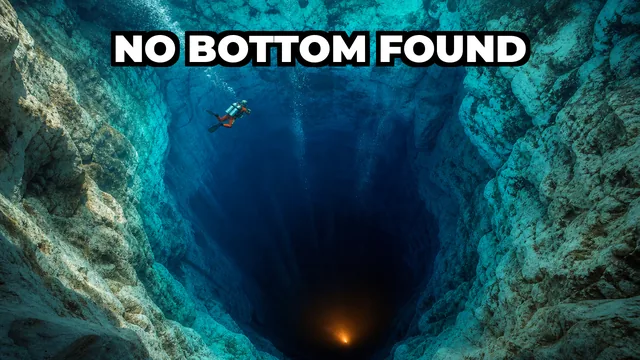 0:19
0:19Divers Went 1,325ft Down — Still No Bottom 🌊
Aug 24, 2026 0:17
0:17