The deepest parts of the ocean are home to extraordinary creatures including giant tube worms, eyeless shrimp, transparent-headed fish, and potentially immortal sharks that survive in crushing darkness under pressures 1,000 times greater than at sea level. These alien-like organisms have evolved remarkable adaptations that challenge our understanding of where and how life can exist on Earth.
The Hadal Zone: Earth’s Final Frontier
The deepest regions of our oceans, known as the hadal zone, extend from 6,000 to 11,000 meters below the surface. This realm of perpetual darkness experiences crushing pressures equivalent to 50 jumbo jets stacked on top of your body, yet it teems with life forms so bizarre they seem pulled from science fiction.
Despite covering more than 65% of our planet’s surface, we’ve explored less than 20% of the deep ocean. Remarkably, we have more detailed maps of Mars than of our own ocean floor, making every deep-sea expedition a journey into the truly unknown.
Creatures That Defy Evolution’s Rules
The Immortal Wanderers
Greenland sharks represent one of the ocean’s most astounding discoveries. Scientists have carbon-dated specimens at approximately 392 years old, meaning individual sharks alive today were swimming before the American Revolution. These nearly blind giants move at less than one mile per hour through total darkness, yet somehow survive for centuries in conditions that would kill most life forms within minutes.
Living Fossils of the Deep
The vampire squid, despite its name, is neither squid nor octopus but the sole surviving member of its own ancient order—a 300-million-year-old living fossil. When threatened, it performs a terrifying defensive maneuver, inverting its cloak-like webbing to transform into a spiky ball while releasing clouds of bioluminescent mucus that weaponizes light itself.
Extreme Adaptations for Extreme Environments
Transparent Skulls and Rotating Eyes
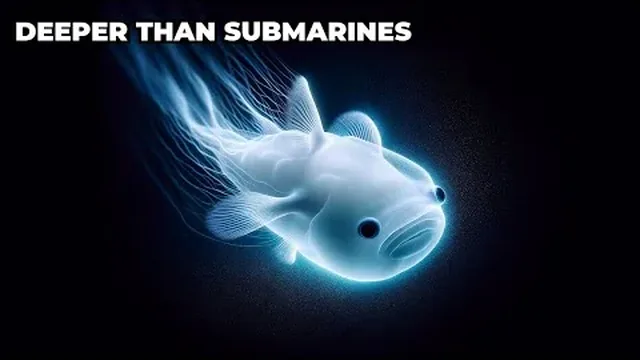
The barreleye fish showcases one of evolution’s most peculiar solutions to deep-sea hunting. Its completely transparent head allows its tubular eyes to rotate freely within its skull, tracking prey above while remaining motionless in the water. Scientists studied this creature for decades before discovering its eye-rotation ability in 2009.
Colonial Organisms
Siphonophores challenge our very definition of what constitutes a single organism. Stretching up to 150 feet long—potentially the longest animals on Earth—they consist of thousands of specialized clones called zooids. Some zooids only eat, others only reproduce, and still others only swim, creating a colonial intelligence that functions as one massive creature.
Hydrothermal Vents: Oases of Impossible Life
Perhaps the most shocking deep-sea discovery came from hydrothermal vents, where water temperatures exceed 700°F—hot enough to melt lead. Rather than being lifeless wastelands, these underwater geysers support thriving ecosystems of eight-foot tube worms, ghostly white crabs, and eyeless shrimp that navigate by sensing heat.
This discovery didn’t merely surprise biologists—it fundamentally rewrote our understanding of habitable zones throughout the universe. Life doesn’t just survive in these scalding conditions; it flourishes, suggesting that similar extreme environments on other planets might also harbor life.
The Ocean’s Hidden Weapons
Microscopic Solar Furnaces
The pistol shrimp, small enough to fit in your palm, creates one of nature’s most violent phenomena. Its claw snap generates a cavitation bubble reaching 8,000°F—approaching the sun’s surface temperature. This process, called sonoluminescence, produces actual visible light and remains partially unexplained by physics.
Chemical Warfare Specialists
Zombie worms (Osedax) have evolved perhaps the most alien feeding strategy on Earth. Lacking mouths, stomachs, or digestive systems, they secrete acid through their skin to drill into whale bones, then host colonies of bacteria inside their bodies to digest the bone material. They’re living chemical weapons that outsource their digestion to internal microbes.
Mysteries Still Unsolved
The deep ocean continues to yield discoveries that challenge scientific understanding. In 1997, NOAA hydrophones detected “The Bloop”—the loudest biological sound ever recorded, originating from the deepest, most remote Pacific coordinates. Whatever produced this sound would have to be dramatically larger than any known animal.
Even more unsettling is the discovery of human-made plastic debris at Challenger Deep, the deepest point on Earth. Humanity had contaminated this most inaccessible place before ever visiting it, revealing the far-reaching impact of human activity on even the planet’s most remote ecosystems.
The Implications for Life Beyond Earth
These deep-sea discoveries have profound implications for astrobiology and our search for extraterrestrial life. If life can thrive in the crushing depths of Earth’s oceans, in boiling acidic water, and in complete darkness for centuries, then the potential habitable zones in our universe expand dramatically.
The deep ocean remains our planet’s greatest frontier, with new species discovered on virtually every expedition. As we continue exploring these alien realms beneath our feet, each discovery forces us to expand our definition of where and how life can exist—both on Earth and potentially throughout the cosmos.
FREQUENTLY ASKED
How deep is the deepest part of the ocean? ▾
The deepest part of the ocean is Challenger Deep in the Mariana Trench, reaching approximately 36,200 feet (11,034 meters) below sea level.
What is the oldest living creature in the deep ocean? ▾
Greenland sharks are among the oldest, with some specimens carbon-dated at around 392 years old, though some deep-sea sponges and corals may live even longer.
Why do deep sea creatures look so strange? ▾
Deep-sea creatures evolved extreme adaptations to survive crushing pressure, total darkness, and scarce food, resulting in features like bioluminescence, transparent bodies, and oversized mouths.