Yes, Saturn’s moon Enceladus harbors a vast liquid ocean beneath its icy surface that contains all the essential ingredients for life as we know it. Scientists have confirmed the presence of liquid water, organic compounds, and energy sources that could potentially support microbial life.
Discovery of Enceladus’s Hidden Ocean
The discovery of Enceladus’s subsurface ocean represents one of the most significant findings in astrobiology. NASA’s Cassini spacecraft, which orbited Saturn from 2004 to 2017, provided compelling evidence through gravity measurements and direct observation of water plumes erupting from the moon’s south pole. These dramatic geysers shoot water vapor and ice particles hundreds of kilometers into space, offering scientists unprecedented access to samples from an alien ocean.
The Perfect Recipe for Life
Enceladus possesses what astrobiologists call the “habitable trinity” - liquid water, organic molecules, and an energy source. The moon’s ocean contains dissolved salts and organic compounds, including methane and hydrogen sulfide. Most importantly, the Cassini mission detected molecular hydrogen in the plumes, indicating active hydrothermal processes on the ocean floor similar to those found around Earth’s deep-sea vents where life thrives.
Hydrothermal Activity and Energy Sources
The ocean floor of Enceladus likely features hydrothermal vents powered by tidal heating from Saturn’s gravitational pull. This process generates the heat necessary to maintain liquid water and drive chemical reactions that could support life. The interaction between the rocky core and the ocean creates the same type of environment where some scientists believe life first emerged on Earth billions of years ago.
Implications for Astrobiology
The discovery of Enceladus’s habitable ocean has revolutionized our understanding of where life might exist in our solar system. Unlike the traditional “Goldilocks zone” around stars, Enceladus demonstrates that habitable environments can exist far from the Sun, heated internally rather than by solar radiation. This dramatically expands the number of potentially habitable worlds throughout the universe.
Future Exploration Missions
Several proposed missions aim to further investigate Enceladus’s potential for life. These include orbiter missions that would sample the plumes more extensively and potentially detect biosignatures - chemical indicators of living processes. The relatively easy access to ocean material through the surface plumes makes Enceladus an ideal target for life detection missions compared to other icy moons that would require drilling through kilometers of ice.
FREQUENTLY ASKED
How deep is the ocean on Enceladus? ▾
The global ocean beneath Enceladus's ice shell is estimated to be about 10 kilometers deep, with the ice crust ranging from 20-25 kilometers thick at the south pole to potentially 35 kilometers thick elsewhere.
Could we actually find living organisms in Enceladus's ocean? ▾
While the conditions appear suitable for microbial life, we haven't detected actual organisms yet - future missions equipped with advanced instruments could potentially identify biosignatures or even living microbes in the plume material.
How do the water plumes on Enceladus form? ▾
The plumes result from tidal heating that creates cracks in the ice shell, allowing pressurized ocean water to escape through these fissures and erupt into space like geysers.
What essential ingredients for life has Cassini found on Enceladus? ▾
Cassini discovered all three components of the 'habitable trinity' on Enceladus: liquid water, organic compounds (including methane and hydrogen sulfide), and energy sources indicated by molecular hydrogen from hydrothermal activity. These are the same basic ingredients that support life on Earth.
How does Enceladus stay warm enough to have liquid water so far from the Sun? ▾
Enceladus maintains its liquid ocean through tidal heating caused by Saturn's gravitational pull, which generates internal heat and powers hydrothermal vents on the ocean floor. This internal heating system works independently of solar radiation, unlike planets in the traditional 'Goldilocks zone.'
Why is Enceladus easier to study for signs of life than other icy moons? ▾
Enceladus offers direct access to its ocean material through water plumes that shoot hundreds of kilometers into space from its south pole. This eliminates the need to drill through kilometers of ice like would be required on other icy moons.
GO DEEPER
KEEP EXPLORING
 0:49
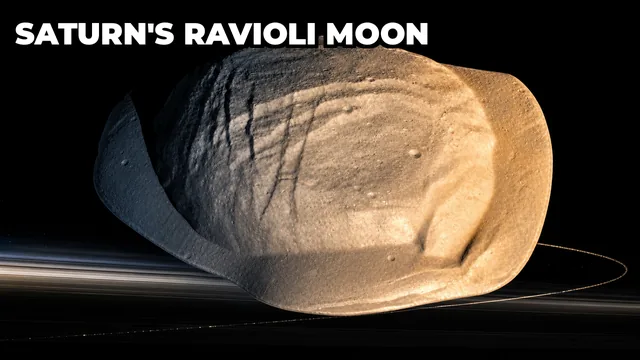
0:49Saturn Is Hiding A Moon Shaped Like Ravioli 🍝
Oct 3, 2026 0:32
0:32NASA Built It For 5 Flights. It Flew 72 On Mars 🚁
Sep 30, 2026 0:31
0:31The Cloud That Forms 52 Miles Up From Meteor Smoke ✨
Sep 30, 2026 0:16
0:16The Only Color Photos Ever Taken On Venus 📸
Sep 27, 2026 0:51
0:51Mars Grows 'Spiders' Every Spring 🕷️ Here's Why
Sep 26, 2026 0:23
0:23