The Short Answer
On December 26, 1900, three experienced lighthouse keepers — James Ducat, Thomas Marshall, and Donald MacArthur — vanished without a trace from the remote Flannan Isles lighthouse off the Scottish coast, and their disappearance has never been officially explained beyond a probable death by rogue wave.
What Was Found at the Lighthouse
When the relief vessel Hesperus arrived at the Flannan Isles — a cluster of small, uninhabited islands roughly twenty-one miles west of the Outer Hebrides — the crew expected a routine handover. What they found instead was one of the most unsettling scenes in Scottish maritime history. The lighthouse was eerily intact but abandoned. Inside, an overturned chair lay on the floor. A clock had stopped. One oilskin coat remained hanging by the door — an almost impossible detail, given how brutal Atlantic weather could be. Most disturbingly, the log entries suggested something had terrified the men in the days before they vanished. Marshall’s final entries described violent storms and waves of extraordinary size. His last recorded words noted that the men had been praying.
The Official Explanation
Superintendent Robert Muirhead led the formal investigation and concluded that all three men had most likely been swept off the rocks by a sudden and catastrophic wave while securing equipment near the shore. The west landing area showed clear signs of damage consistent with extreme wave activity — iron railings bent, rock debris displaced, and ropes scattered far from their normal positions. The theory is plausible. Rogue waves in the North Atlantic are real, documented, and deadly. However, the conclusion remained speculative. No bodies were ever recovered. No clothing. No physical evidence of the men themselves — not in 1900, not in the 120-plus years since.
The Stevenson Connection
The Flannan Isles lighthouse was designed by David Alan Stevenson, a member of the famous Stevenson engineering dynasty responsible for many of Scotland’s lighthouse network. David was the cousin of Robert Louis Stevenson, the author of Treasure Island. The fact that a building conceived within a family defined by adventure and storytelling became the setting for one of history’s most enduring real mysteries is a detail that feels almost too literary to be accidental.
Why No Explanation Has Fully Satisfied
Several alternative theories have circulated over the decades. Some have proposed a violent argument between the men leading to deaths and a cover-up — though evidence for this is essentially nonexistent. Others have pointed to waterspouts, freak weather events, or even seismic sea disturbances. The eerie details inside the lighthouse — particularly the half-prepared meal and the single coat left behind — suggest the men left in sudden, panicked haste rather than following any planned routine. That urgency, combined with the total absence of any physical remains, is what keeps the case alive in the public imagination.
The Lighthouse After 1900
Despite the disappearance, the Flannan Isles lighthouse continued operating with manned crews for seven more decades. Keepers were posted there until the lighthouse was finally automated in 1971. In that span of seventy-one years, no further supernatural or inexplicable events were officially recorded — which, depending on your interpretation, either supports the mundane wave hypothesis or simply means the rocks kept their secrets more carefully the second time around.
The Mystery Today
The Flannan Isles case remains one of Scotland’s most studied and most discussed historical mysteries. It has inspired poems, novels, operas, and films. The island itself is now a designated nature reserve, largely inaccessible to the public. The lighthouse still stands. And the three men — Ducat, Marshall, and MacArthur — remain, officially, missing.
FREQUENTLY ASKED
Who were the three lighthouse keepers who disappeared at Flannan Isles? ▾
The three keepers were James Ducat, Thomas Marshall, and Donald MacArthur, all experienced Scottish lighthouse workers stationed at the remote Flannan Isles lighthouse in 1900.
When did the Flannan Isles lighthouse keepers disappear? ▾
The keepers were discovered missing on December 26, 1900, when the relief vessel Hesperus arrived for a routine crew change and found the lighthouse completely abandoned.
What is the most likely explanation for the Flannan Isles disappearance? ▾
The official investigation concluded the men were most likely swept into the sea by a massive rogue wave while securing equipment near the shore, though no bodies were ever recovered to confirm this.
Were any bodies ever found from the Flannan Isles lighthouse mystery? ▾
No — not a single body, piece of clothing, or physical trace of any of the three men has ever been recovered in over 120 years.
Is the Flannan Isles lighthouse still standing today? ▾
Yes, the lighthouse still stands on the Flannan Isles and was automated in 1971 after being continuously manned for seven decades following the 1900 disappearance.
What did the lighthouse log say before the keepers vanished? ▾
Thomas Marshall's final log entries described terrifyingly violent storms and unusually large waves, with one entry noting that the men had been praying — suggesting extreme fear in the days before they disappeared.
KEEP EXPLORING
 0:42
0:42They Paved a Roman Road With a 7ft Ancient Statue 🏛️
Oct 6, 2026 0:43
0:43Earth's 4th-Largest Lake Is Now A Salt Desert 🏜️
Oct 4, 2026 0:52
0:52A 160-Ton Obelisk Flew Home After 68 Years ✈️
Oct 4, 2026 0:19
0:19They Built A 41ft Ring From 60 Mammoths 🦣
Oct 3, 2026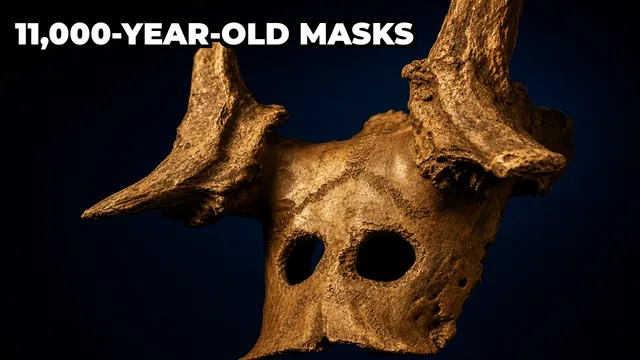 0:05
0:0533 Deer Skull Masks — 11,000 Years Old 🦌😱
Oct 2, 2026 0:34
0:34