Gliese 436b is a Neptune-sized exoplanet located 43 light-years from Earth that features ‘burning ice’ - water that remains solid despite surface temperatures reaching 4,400 degrees Fahrenheit due to the planet’s extreme gravitational compression. This phenomenon creates superionic ice, an exotic state of matter that was purely theoretical until this planet’s discovery.
The Discovery of an Impossible World
Astronomers first identified Gliese 436b orbiting a red dwarf star in the constellation Leo. What made this discovery extraordinary wasn’t just finding another exoplanet, but encountering a world that seemed to violate basic physics. The planet’s surface temperature exceeds that of molten lava, yet water exists there in solid form - creating what scientists dramatically call ‘burning ice.’
The planet completes an orbit around its host star in just 2.6 Earth days, placing it extremely close to its stellar companion. This proximity subjects Gliese 436b to intense radiation and heat, creating the scorching surface conditions that should logically vaporize any water present.
Understanding Superionic Ice
The key to Gliese 436b’s impossible ice lies in its crushing gravitational field. The planet’s mass creates pressure so intense that water molecules are compressed into a solid state regardless of temperature. This creates superionic ice - a phase of matter where water maintains a crystalline structure while individual hydrogen ions move freely through the solid oxygen lattice.
This state of matter exists at pressures millions of times greater than Earth’s atmosphere. Under these conditions, the normal rules governing phase transitions break down. Water cannot expand into gas or liquid form because the gravitational compression overpowers the thermal energy trying to break molecular bonds.
Rewriting Physics Books
Before Gliese 436b’s discovery, superionic ice existed only in theoretical physics models. Scientists had predicted its possibility through mathematical calculations, but finding it in nature forced a reevaluation of planetary science. The discovery demonstrated that exotic states of matter aren’t confined to laboratory conditions or the cores of gas giants.
This finding has implications beyond just one unusual planet. It suggests that similar exotic matter states might exist throughout the universe, hidden on worlds with extreme conditions. The discovery expanded our understanding of how matter behaves under intense pressure and temperature combinations.
Implications for Planetary Science
Gliese 436b represents a new category of exoplanet that challenges traditional classification systems. Its existence suggests that planets can maintain complex chemical compositions under far more extreme conditions than previously thought possible. This opens new possibilities for where and how we might find unusual worlds throughout the galaxy.
The planet’s unique properties also provide insights into planetary formation and evolution. Understanding how such extreme conditions develop helps astronomers predict what other impossible worlds might be waiting for discovery in our cosmic neighborhood.
The Broader Universe
The existence of Gliese 436b raises profound questions about what other seemingly impossible worlds exist beyond our solar system. If a planet of burning ice can exist, what other combinations of extreme physics might nature have created? Each new exoplanet discovery continues to expand the boundaries of what we consider possible in planetary science, reminding us that the universe consistently exceeds our imagination.
FREQUENTLY ASKED
How far away is Gliese 436b from Earth? ▾
Gliese 436b is located 43 light-years away from Earth in the constellation Leo, orbiting a red dwarf star.
How hot is the burning ice on Gliese 436b? ▾
The surface temperature of Gliese 436b reaches 4,400 degrees Fahrenheit, which is hotter than molten lava but the ice remains solid due to extreme gravitational pressure.
What is superionic ice made of? ▾
Superionic ice is water compressed under extreme pressure where oxygen atoms form a solid crystalline structure while hydrogen ions move freely through it, creating a unique state of matter.
How long does it take Gliese 436b to orbit its star? ▾
Gliese 436b completes an orbit around its host star in just 2.6 Earth days. This extremely short orbital period places the planet very close to its stellar companion, subjecting it to intense radiation and heat.
What type of star does Gliese 436b orbit? ▾
Gliese 436b orbits a red dwarf star located in the constellation Leo. The planet's close proximity to this star creates the extreme conditions that lead to its burning ice phenomenon.
Why can't water on Gliese 436b turn into gas despite the extreme heat? ▾
The planet's crushing gravitational field creates pressure millions of times greater than Earth's atmosphere, preventing water from expanding into gas or liquid form. This gravitational compression overpowers the thermal energy trying to break the molecular bonds.
GO DEEPER
KEEP EXPLORING
 0:54
0:54NASA Lost Track of Its Moon Trees for 20 Years 🌳🌕
Oct 23, 2026 0:21
0:21Where Space Stations Go to Rest 🌊 (1,670 Miles From Land)
Oct 20, 2026 0:42
0:42It Bounced Off a Comet & Vanished for 2 Years 🚀
Oct 17, 2026 0:49
0:49NASA Lost an 84-Ton Station… & Got a $400 Fine 🛸
Oct 14, 2026 0:24
0:24We Finally Saw the Sun's Hidden Pole 🌞😱
Oct 11, 2026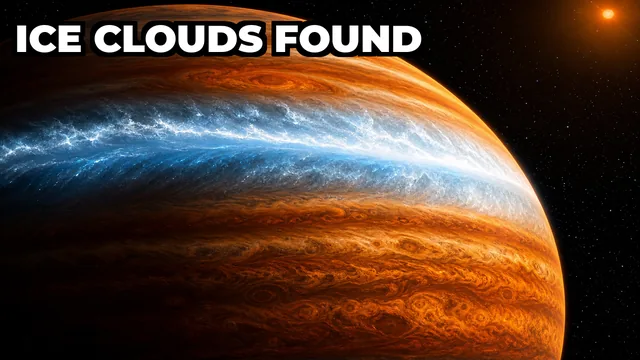 0:50
0:50