The Universe’s Most Impossible Structure
The Hercules-Corona Borealis Great Wall is a cosmic structure spanning approximately 10 billion light-years across, making it the largest known structure in the observable universe. This massive galactic filament violates fundamental principles of cosmology by being roughly eight times larger than what current physics models allow.
Discovery Through Gamma-Ray Burst Patterns
In 2013, astronomers István Horváth, Jon Hakkila, and Zsolt Bagoly made this groundbreaking discovery not through direct observation, but by analyzing patterns in gamma-ray bursts (GRBs). These incredibly powerful explosions, among the most energetic events in the universe, appeared to cluster in an impossible configuration that suggested an underlying massive structure.
The team analyzed data from the Swift Gamma-Ray Burst Mission and noticed that GRBs weren’t distributed randomly across the sky as expected. Instead, they formed a pattern indicating the presence of something vast and organized—a cosmic wall of galaxies and dark matter stretching across billions of light-years.
Why This Structure Shouldn’t Exist
The cosmological principle, a cornerstone of modern astrophysics, states that the universe should be homogeneous and isotropic on large scales. According to this principle and our understanding of cosmic evolution, no structure should exceed approximately 1.2 billion light-years in size.
The reason lies in the age of the universe itself. At roughly 13.8 billion years old, there simply hasn’t been enough time for gravitational forces to organize matter into structures spanning 10 billion light-years. Even traveling at the speed of light, information and gravitational influences couldn’t coordinate the formation of something so massive within the universe’s current timeframe.
Implications for Cosmology
If the Hercules-Corona Borealis Great Wall truly exists as described, it challenges our fundamental understanding of cosmic evolution and structure formation. The discovery suggests several troubling possibilities:
First, our models of how the universe evolved may be incomplete or incorrect. The standard model of cosmology, which includes dark matter and dark energy, might need significant revision to account for such massive structures.
Second, the cosmological principle itself might not hold true at the largest scales, meaning the universe may be far more lumpy and organized than we previously believed.
Scale Beyond Comprehension
To understand the sheer magnitude of this structure, consider that it spans roughly one-ninth of the entire observable universe. If you could somehow view the cosmos from an impossible external perspective, this single structure would dominate your field of vision.
The Great Wall contains billions of galaxies, each containing hundreds of billions of stars. The amount of matter involved in this structure is almost incomprehensible, representing one of the largest concentrations of mass and energy in the known universe.
Ongoing Research and Debate
The scientific community continues to debate both the existence and implications of the Hercules-Corona Borealis Great Wall. Some researchers question whether the gamma-ray burst clustering truly indicates a single coherent structure, while others argue that statistical analysis supports its reality.
Further observations and improved statistical methods will be necessary to confirm or refute this discovery. If validated, it will force astronomers to reconsider fundamental assumptions about cosmic evolution and structure formation on the largest scales.
FREQUENTLY ASKED
How was the Hercules-Corona Borealis Great Wall discovered? ▾
It was discovered in 2013 through the analysis of gamma-ray burst patterns that showed unusual clustering, indicating an underlying massive structure.
Why is the Great Wall considered impossible according to physics? ▾
Current cosmological models state that no structure should exceed 1.2 billion light-years, but the Great Wall spans 10 billion light-years—eight times the theoretical limit.
Can we see the Hercules-Corona Borealis Great Wall directly? ▾
No, it cannot be observed directly and was only detected through statistical analysis of gamma-ray burst distributions across the sky.
What percentage of the observable universe does this structure occupy? ▾
The Great Wall spans approximately one-ninth of the entire observable universe, which is roughly 93 billion light-years across.
Could the Great Wall discovery be a statistical error? ▾
Some scientists debate this possibility, as the structure was identified through pattern analysis rather than direct observation.
What would this discovery mean for our understanding of cosmology? ▾
If confirmed, it would require significant revisions to the standard model of cosmology and our understanding of how large-scale structures form.
GO DEEPER
KEEP EXPLORING
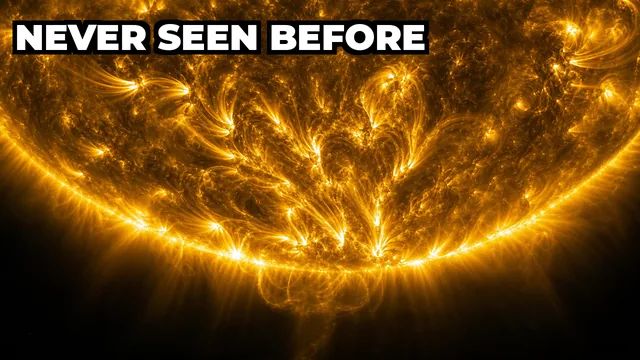 0:24
0:24We Finally Saw the Sun's Hidden Pole 🌞😱
Oct 11, 2026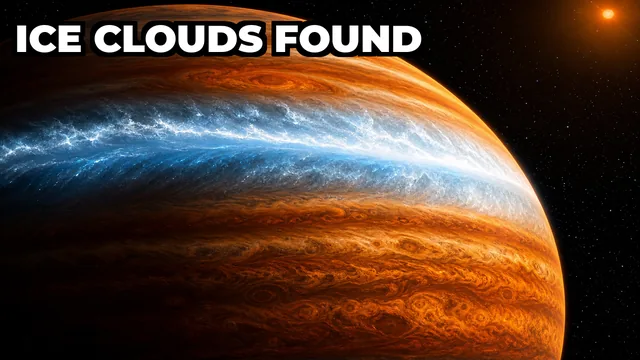 0:50
0:50Webb Found Ice Clouds 12 Light-Years Away 🌌
Oct 9, 2026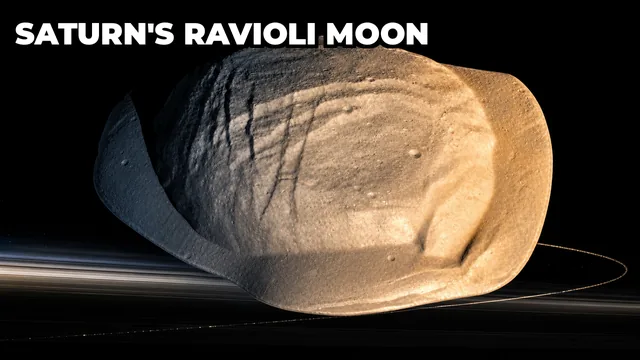 0:49
0:49Saturn Is Hiding A Moon Shaped Like Ravioli 🍝
Oct 3, 2026 0:32
0:32NASA Built It For 5 Flights. It Flew 72 On Mars 🚁
Sep 30, 2026 0:31
0:31The Cloud That Forms 52 Miles Up From Meteor Smoke ✨
Sep 30, 2026 0:16
0:16