The Indus Valley Script remains undeciphered after a century of scholarly attempts because no bilingual text—like the Rosetta Stone used to crack Egyptian hieroglyphs—has ever been discovered. This absence of a translation key, combined with the script’s brief inscriptions and unknown language family, has made it archaeology’s most enduring mystery.
The Scale of the Lost Civilization
The Harappan civilization (2600-1900 BCE) was a marvel of the ancient world, spanning over one million square kilometers across more than 1,500 cities. This massive civilization covered an area larger than ancient Egypt and Mesopotamia combined, supporting an estimated 10% of the world’s population at its peak. Their cities featured sophisticated urban planning with advanced drainage systems that wouldn’t appear in Europe for another 4,000 years.
Despite this extraordinary scale and technological advancement, every written record they left behind—approximately 4,000 distinct symbols found on seals, pottery, and tablets—remains completely silent to modern scholars.
The Missing Key: No Rosetta Stone
The primary obstacle to decipherment lies in the absence of a bilingual inscription. When Jean-François Champollion cracked Egyptian hieroglyphs in 1822, he relied on the Rosetta Stone, which contained the same text in three scripts including known Greek. For the Indus script, no such comparative text exists.
This fundamental challenge is compounded by several factors:
- Most inscriptions are extremely short, averaging only 4-5 symbols
- The underlying language is unknown and may be from an extinct language family
- The script appears to be logo-syllabic, mixing word-signs with syllabic elements
- No clear descendant writing system has been identified
Evidence of Structured Language
Despite the decipherment challenges, computational analysis has provided crucial insights. A landmark 2009 study published in Science magazine analyzed the statistical patterns within Indus inscriptions using mathematical models. The research found that the symbol sequences follow patterns consistent with structured language rather than random pictographs or simple accounting marks.
This finding suggests that meaningful linguistic content is indeed locked within these ancient symbols—we simply lack the key to unlock it.
The Stakes of Forever Silence
The failure to decipher the Indus script represents more than an academic puzzle. An entire civilization’s intellectual, spiritual, and cultural life remains inaccessible to us. Their religious beliefs, social structures, trade relationships, and daily concerns—all the human elements that bring ancient peoples to life—stay forever locked away.
If the script is never decoded, we lose the voices of millions of people who lived, worked, and thrived in one of humanity’s earliest urban civilizations. Their cities may have been excavated, but their thoughts remain buried.
The Search Continues
Scholars continue developing new approaches, from artificial intelligence analysis to comparative studies with other ancient scripts. Each new archaeological discovery brings hope for finding that elusive bilingual text or longer inscription that could provide the breakthrough.
Until then, the Harappan people continue their 4,000-year whisper across time—a civilization speaking to us in a language we cannot yet understand.
FREQUENTLY ASKED
How many Indus Valley symbols have been discovered? ▾
Approximately 4,000 distinct symbols have been identified across Indus Valley archaeological sites, though most inscriptions are very short.
What happened to the Indus Valley civilization? ▾
The Harappan civilization declined around 1900 BCE, possibly due to climate change, river course changes, or other environmental factors, though the exact cause remains unknown.
Could artificial intelligence decode the Indus script? ▾
AI has shown promise in pattern analysis, but without a bilingual key or longer texts, even advanced computational methods face significant limitations in full decipherment.
Why is the Indus Valley script so hard to decode compared to Egyptian hieroglyphs? ▾
Unlike Egyptian hieroglyphs, which were deciphered using the Rosetta Stone that contained the same text in three scripts including known Greek, no bilingual text has ever been discovered for the Indus script. Additionally, most Indus inscriptions are extremely short (averaging only 4-5 symbols) and the underlying language is completely unknown.
How large was the Harappan civilization? ▾
The Harappan civilization spanned over one million square kilometers across more than 1,500 cities, covering an area larger than ancient Egypt and Mesopotamia combined. At its peak, it supported an estimated 10% of the world's population.
Do scholars think the Indus symbols represent real language or just pictures? ▾
A 2009 study published in Science magazine found that the symbol sequences follow patterns consistent with structured language rather than random pictographs or simple accounting marks. This suggests the symbols contain meaningful linguistic content, though we lack the key to decode it.
GO DEEPER
KEEP EXPLORING
 0:42
0:42They Paved a Roman Road With a 7ft Ancient Statue 🏛️
Oct 6, 2026 0:49
0:49This Iron Pillar Refused To Rust For 1,600 Years ⚙️
Oct 5, 2026 0:52
0:52A 160-Ton Obelisk Flew Home After 68 Years ✈️
Oct 4, 2026 0:19
0:19They Built A 41ft Ring From 60 Mammoths 🦣
Oct 3, 2026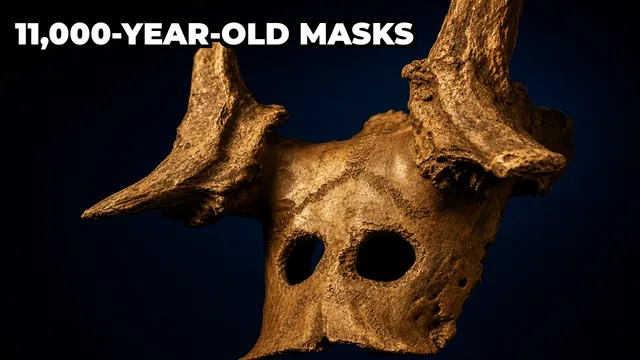 0:05
0:0533 Deer Skull Masks — 11,000 Years Old 🦌😱
Oct 2, 2026 0:34
0:34