What Did James Webb Discover That Challenges the Big Bang Theory?
April 4, 2026
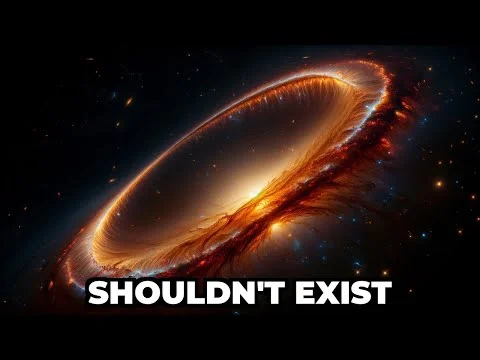
The James Webb Space Telescope has discovered fully mature galaxies that existed just 500 million years after the Big Bang, challenging our fundamental understanding of cosmic evolution. These galaxies are approximately six times larger than current physics models predict should be possible for such an early period in the universe’s history.
The Impossible Discovery
When the James Webb Space Telescope began peering deeper into space than ever before, astronomers expected to find small, primitive galaxies in the early universe. Instead, they found massive, fully-formed galactic structures that appear to have developed far too quickly according to our current understanding of cosmology.
These ancient galaxies display characteristics that should have taken billions of years to develop, not the mere 500 million years that had passed since the Big Bang. The discovery has left scientists scrambling to explain how such complex structures could form so rapidly in the universe’s infancy.
Why This Challenges Current Physics
According to the standard model of cosmology, the early universe was a relatively simple place filled with hydrogen and helium gas. Stars and galaxies were supposed to form gradually through a process called hierarchical structure formation, where small objects merged to create progressively larger ones over billions of years.
The newly discovered galaxies are not only unexpectedly large but also show signs of advanced stellar populations and complex internal structures. This suggests that either our timeline for cosmic evolution is drastically wrong, or unknown physical processes were at work in the early universe.
Implications for the Big Bang Theory
While these findings don’t necessarily disprove the Big Bang theory entirely, they do suggest that significant modifications may be needed to our understanding of early cosmic evolution. Some scientists are proposing alternative theories, including the possibility that galaxy formation occurred much more rapidly than previously thought possible.
Other researchers suggest that dark matter may have behaved differently in the early universe, allowing for accelerated structure formation. Some even propose that our understanding of fundamental physics may need revision to account for these observations.
What Scientists Are Saying
The astronomical community remains divided on the implications of these discoveries. While some researchers call for major revisions to cosmological models, others urge caution, suggesting that improved analysis techniques or additional observations might resolve the apparent contradictions.
What’s clear is that the James Webb Space Telescope has opened a new chapter in our understanding of the cosmos, one that may require us to fundamentally reconsider how the universe evolved from its earliest moments to the complex structure we see today.
FREQUENTLY ASKED
How old are the galaxies discovered by James Webb? ▾
The galaxies existed when the universe was only 500 million years old, making them among the earliest known galactic structures.
Could these discoveries prove the Big Bang theory wrong? ▾
While they challenge current models, these findings more likely require modifications to our understanding rather than complete rejection of the Big Bang theory.
Why are these galaxies considered impossible? ▾
They are six times larger than physics models predict should be possible so early in the universe's history, when there wasn't enough time for such massive structures to form.