What Is the Kostenki 11 Mammoth Bone Circle?
Kostenki 11 is a roughly 41-foot-wide circular structure built from the bones of at least 60 individual mammoths approximately 25,000 years ago near Voronezh, Russia — making it one of the oldest and most enigmatic Ice Age constructions ever discovered in Europe.
Discovery and Publication
The site sits on the western bank of the Don River, in a region of Russia long known for its remarkable Paleolithic archaeology. Excavations revealed the structure in 2014, but the findings reached a global audience in 2020 when Alexander Pryor of the University of Exeter and his colleagues published a detailed analysis in the journal Antiquity. The study confirmed the ring’s extraordinary scale, its deliberate construction, and the presence of charred plant remains and wood ash within its interior — clear evidence that fires were lit inside the circle, and lit repeatedly.
What the Ring Is Made Of
The structure incorporates skulls, tusks, jaw bones, and limb bones from a minimum of 60 mammoths. These were not scattered randomly. They were arranged with clear intention into a near-perfect circle, with different bone types appearing to occupy specific positions within the ring’s wall. The sheer number of animals represented suggests either a mass hunting event or the systematic collection of bones over an extended period — both of which imply significant social organization among the people who built it.
The Ice Age Context
The builders lived at the onset of the Last Glacial Maximum, the coldest phase of the most recent Ice Age. Near Voronezh, winter temperatures likely dropped to around -20°C (approximately 4°F below zero Fahrenheit). Resources were scarce. Wood was rare on the open steppe. The mammoth — with its bones, hide, fat, and meat — was likely central to survival. Building an enormous monument from mammoth remains under these conditions was not a trivial act. It demanded time, coordination, and a reason.
Why Were Fires Burning Inside?
This is the detail that makes Kostenki 11 genuinely puzzling. Fires were demonstrably lit within the ring. Yet the structure was far too large — at 41 feet across — to have supported a roof of any practical kind. This rules out a simple interpretation as a dwelling or windbreak. Pryor’s team proposed that the site may have functioned as a communal gathering place, possibly used for social or ceremonial purposes. The word “ritual” appears carefully but meaningfully in the published research.
What Archaeologists Think It Means
Kostenki 11 may represent one of the earliest known examples of a purpose-built communal space in Europe — a place where Ice Age hunter-gatherers came together not merely to survive, but to do something more. What exactly that something was remains unresolved. The site does not fit neatly into any single category: it is too large to be a house, too structured to be a dump, and too fire-marked to be purely symbolic. It exists at the intersection of the practical and the meaningful — which is, perhaps, exactly where early human culture always lived.
Why Kostenki 11 Matters
Structures like Kostenki 11 push back the timeline for complex, organized human behavior in Europe. They suggest that even without agriculture, metals, or writing, Paleolithic people were capable of large-scale collaborative construction and possibly held beliefs or social traditions sophisticated enough to demand a dedicated physical space. Twenty-five thousand years later, the bones still hold their circle. The question of why they were arranged this way remains one of archaeology’s most compelling open problems.
FREQUENTLY ASKED
How old is the Kostenki 11 mammoth bone circle? ▾
The Kostenki 11 structure is approximately 25,000 years old, dating to the onset of the Last Glacial Maximum during the Paleolithic era.
Where is the Kostenki 11 site located? ▾
It is located near Voronezh, Russia, on the western bank of the Don River, in a region with a long history of Paleolithic archaeological discoveries.
How many mammoths were used to build the Kostenki 11 ring? ▾
Remains from at least 60 individual mammoths were identified in the structure, including skulls, tusks, jaw bones, and limb bones.
Who discovered and published the Kostenki 11 findings? ▾
The site was excavated in 2014, and the findings were published in the journal Antiquity in 2020 by Alexander Pryor of the University of Exeter and his research team.
Could the Kostenki 11 mammoth bone ring have been used as a shelter? ▾
It is unlikely to have served as a roofed shelter, since at 41 feet wide it is far too large to have been covered; researchers instead suggest it may have been a communal gathering or ritual space.
Are there other mammoth bone structures similar to Kostenki 11? ▾
Yes, other mammoth bone structures have been found across Eastern Europe and Russia, but Kostenki 11 is among the largest and oldest, and its open-air design with internal fire evidence makes it particularly unusual.
GO DEEPER
KEEP EXPLORING
 0:05
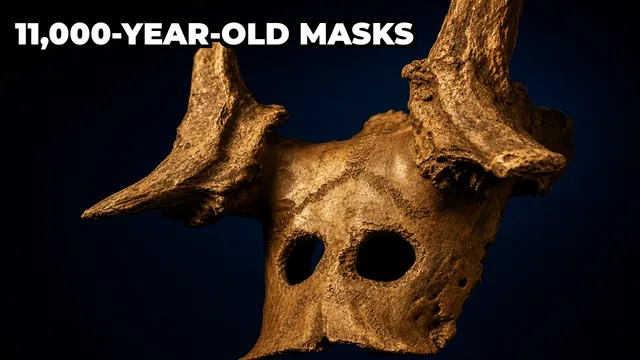
0:0533 Deer Skull Masks — 11,000 Years Old 🦌😱
Oct 2, 2026 0:34
0:34A 72ft Mound Built In 90 Days, 3,200 Years Ago 🪣
Oct 1, 2026 0:37
0:373,400-Year-Old Stairs Still Stand In A Salt Mine 🪜
Sep 30, 2026 0:11
0:112,498 Jade Plates Hid a Secret for 2,000 Years 👑
Sep 28, 2026 0:06
0:06The Sand That Stays Cool At 100°F 🏜️
Sep 28, 2026 0:38
0:38