The Coconut Crab Holds the Title
The coconut crab (Birgus latro) is the largest land-living arthropod on Earth, capable of spanning up to three feet from leg to leg and weighing as much as nine pounds — heavier than most domestic cats.
A Giant That Defies What You Expect from a Crab
Most people picture crabs as small, scuttling sea creatures. The coconut crab shatters that image entirely. Found on tropical islands across the Indian Ocean and parts of the Pacific, this massive arthropod is technically a hermit crab — the largest one in existence. Despite its oceanic ancestry, the adult coconut crab has evolved functional lungs called branchiostegal lungs, organs that allow it to breathe air efficiently. The trade-off is dramatic: keep an adult coconut crab submerged too long, and it will drown.
Claws That Can Crack Bone
The coconut crab’s claws are among the most powerful of any living animal relative to body size. Research published in PLOS ONE measured the grip force of coconut crab claws at up to 3,300 newtons — comparable to the bite force of a lion. Those claws are strong enough to crack open a coconut’s thick husk, which is precisely where the animal gets its name. They are also capable of snapping bone. Reports of coconut crabs injuring humans by crushing fingers or hands are not exaggerated.
An Unlikely Tree Climber
The coconut crab regularly scales palm trees — sometimes to heights of twenty feet or more — to reach coconuts and other fruit. It uses its powerful legs and hooked claws to grip bark and haul its considerable body weight upward. Once it tears a coconut loose, it descends and uses its claws to methodically peel and crack the husk. This behavior is unusual enough in any animal; in a crab, it is extraordinary.
A Lifespan That Rivals Humans
Coconut crabs are slow to mature and long-lived. They can survive for more than forty years in the wild, making them among the longest-lived arthropods known. They grow slowly, molting periodically as they increase in size, and do not reach sexual maturity for several years. This slow life history makes them vulnerable to overhunting, and the species is considered data deficient by the IUCN, with populations declining on islands where they are hunted for food.
The Amelia Earhart Connection
One of the most unsettling theories in the mystery of Amelia Earhart’s 1937 disappearance involves coconut crabs. Researchers examining Nikumaroro Island — a remote coral atoll in the Pacific where Earhart may have made an emergency landing — found fragmentary human bones near the site of a probable campfire. Forensic investigator Tom King and other researchers have proposed that coconut crabs, which are known scavengers, could have scattered and consumed her remains over the decades following her death. No definitive conclusion has been reached, but the hypothesis is taken seriously by scientists who study the case.
Quietly Ruling the Tropics for Millions of Years
Coconut crabs have been present on tropical islands for tens of millions of years, making them one of the most successful large arthropods in evolutionary history. They are omnivores, consuming fruit, nuts, carrion, and even the shells of smaller crustaceans for the calcium needed to harden their own exoskeleton. On islands without natural predators, they can be remarkably bold — approaching campsites and investigating unfamiliar objects with little fear. They are, in almost every sense, apex scavengers of the island floor.
FREQUENTLY ASKED
How strong are coconut crab claws? ▾
Coconut crab claws can exert a grip force of up to 3,300 newtons, enough to crack a coconut's husk or snap a human bone.
Can a coconut crab drown? ▾
Yes — adult coconut crabs have evolved lungs for breathing air, so keeping one submerged for an extended period will cause it to drown.
How long do coconut crabs live? ▾
Coconut crabs can live for more than forty years, making them one of the longest-lived arthropods on Earth.
Did coconut crabs eat Amelia Earhart? ▾
Some researchers believe coconut crabs on Nikumaroro Island may have scattered and consumed Earhart's remains after her 1937 disappearance, though no definitive proof has been established.
Where do coconut crabs live? ▾
Coconut crabs are found on tropical islands across the Indian Ocean and parts of the Pacific, including remote atolls with few or no natural predators.
Are coconut crabs endangered? ▾
Coconut crabs are listed as data deficient by the IUCN, with populations declining on many islands due to overhunting and habitat loss.
GO DEEPER
KEEP EXPLORING
 0:52
0:52A 24 lb Flower With No Roots Tricks Flies 😱
Oct 20, 2026 0:52
0:52Termites or Thirsty Grass? The Desert Can't Decide 🔵
Oct 19, 2026 0:38
0:38The Vampire Squid Escapes in a Cloud of Light 🦑
Oct 19, 2026 0:38
0:38200 Million Termite Mounds, Some 3,800 Years Old 🐜
Oct 17, 2026 0:36
0:36Why This Frog Packs Its Cells With Sugar 🐸🔬
Oct 16, 2026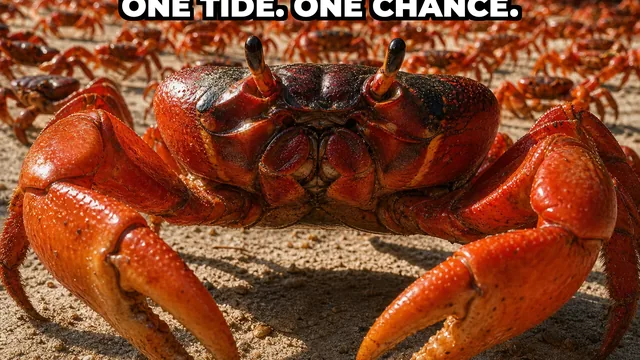 0:58
0:58