The Biggest Snake in Earth’s History
The largest snake ever discovered was Titanoboa cerrejonensis, a prehistoric serpent that stretched approximately thirteen metres long and weighed over 1,135 kilograms — more than a tonne — living in the tropical swamps of what is now northern Colombia between 58 and 60 million years ago.
Fossils From a Coal Mine
Titanoboa was not found in a carefully excavated archaeological dig. Its remains were uncovered in the Cerrejon coal mine in northern Colombia, where miners cracking open ancient rock found vertebrae the size of grapefruits embedded in the seams. Palaeontologists recognised immediately that these bones were extraordinary — far larger than any snake vertebrae on record. The Cerrejon formation, dating to the Paleocene epoch, preserved an entire lost ecosystem: a dense tropical swamp forest teeming with giant turtles, crocodilians, and lungfish. Titanoboa ruled them all.
How Big Was Titanoboa Really?
Thirteen metres is difficult to visualise in the abstract. To put it plainly, Titanoboa was longer than a city bus and heavier than a mature male giraffe. Its body at its widest point would have reached roughly a metre in diameter. For comparison, the largest living snake — the reticulated python — rarely exceeds seven metres and almost never exceeds 160 kilograms. Titanoboa was not simply a bigger python. It was a creature operating on an entirely different scale, belonging to a group called boids, distantly related to modern boas and anacondas.
A Thermometer From Deep Time
The most scientifically astonishing implication of Titanoboa is not its size — it is what its size reveals about ancient climate. Snakes are ectotherms, meaning they rely entirely on environmental heat to regulate their body temperature and drive their metabolism. The physics of ectothermy imposes strict limits: the larger the cold-blooded animal, the hotter the environment must be to sustain it. By working backwards from Titanoboa’s body mass, scientists calculated that mean annual temperatures in the Paleocene tropics reached between 30 and 34 degrees Celsius. That is three to four degrees hotter than any tropical rainforest on Earth today. A single fossilised snake became one of the most precise thermometers ever found for reconstructing ancient climate.
Life After the Dinosaurs
Titanoboa lived only six to eight million years after the mass extinction event that wiped out the non-avian dinosaurs roughly 66 million years ago. In geological terms, that is a blink. The world it inhabited was strange and transitional — mammals were small and cautious, birds were diversifying rapidly, and reptiles had reclaimed enormous ecological space. In this post-dinosaur vacuum, Titanoboa became the apex predator of its environment, ambushing prey in shallow swamp water the way modern anacondas do, but on a scale nothing alive today approaches.
Why It No Longer Exists
As Earth’s climate gradually cooled through the Eocene epoch, the extreme tropical heat that had allowed Titanoboa to reach its extraordinary size disappeared. A cold-blooded animal that large could not survive in a cooler world — its metabolism would simply not function. The snake did not go extinct through catastrophe but through the slow withdrawal of the one thing it depended on entirely: heat. Its disappearance is, in a quiet way, a warning about what climate drives and what climate takes away.
FREQUENTLY ASKED
How long was Titanoboa compared to modern snakes? ▾
Titanoboa reached approximately thirteen metres in length, nearly double the size of the largest reticulated pythons alive today, which rarely exceed seven metres.
Where were Titanoboa fossils discovered? ▾
Titanoboa fossils were found in the Cerrejon coal mine in northern Colombia, where miners uncovered giant vertebrae preserved in Paleocene-era rock formations.
What did Titanoboa eat? ▾
Titanoboa likely ambushed large prey in swampy water, probably including giant crocodilians and large turtles whose fossils were found alongside it in the Cerrejon formation.
What does Titanoboa tell us about ancient climate? ▾
Because large cold-blooded animals require extreme heat to survive, Titanoboa's body size is evidence that Paleocene tropical temperatures averaged 30 to 34 degrees Celsius — far hotter than any tropical forest today.
When did Titanoboa go extinct? ▾
Titanoboa disappeared as global temperatures declined through the Eocene epoch, roughly 45 to 58 million years ago, because cooler conditions could no longer sustain a cold-blooded animal of its mass.
Is Titanoboa related to anacondas or pythons? ▾
Titanoboa belonged to the boid family, making it more closely related to modern boas and anacondas than to pythons, though all are broadly part of the large constrictor lineage.
GO DEEPER
KEEP EXPLORING
 0:43
0:43This 3,500yr-Old Gem Hides Carvings Too Small To See 🔍
Sep 17, 2026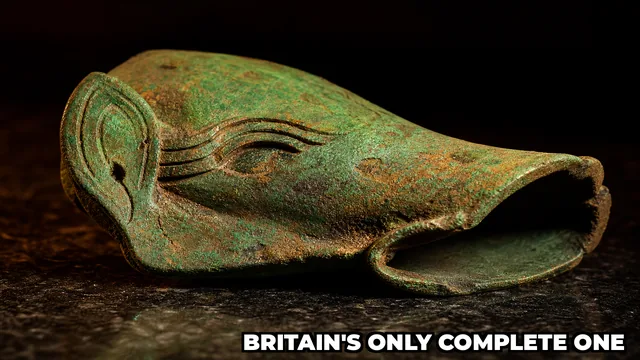 0:26
0:26Britain's Only Complete Celtic Battle Horn 🎺
Sep 17, 2026 0:42
0:42Archaeologists Found What 140 Years of Digging Missed 😱
Sep 16, 2026 0:39
0:399,000-Year-Old Figures Buried Face-Up 👁️ Why?
Sep 15, 2026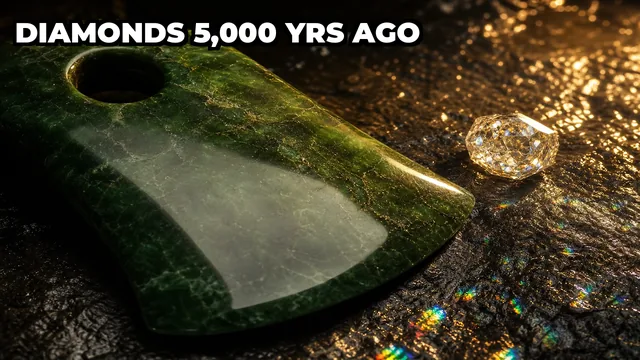 0:26
0:26How Did A Lost Civilization Polish With Diamonds? 💎
Sep 14, 2026 0:30
0:30