A Hidden Volcano and a Mineral from Earth’s Deepest Past
In 2018, scientists discovered a brand-new submarine volcano named Fani Maore rising roughly 800 metres from the seafloor east of Mayotte, and analysis of its lava revealed traces of bridgmanite — a mineral that forms only under extreme lower mantle pressures — making it the first time this mineral had ever been detected in surface volcanic rocks.
The Earthquakes That Started It All
In May 2018, a swarm of earthquakes began rattling the French island of Mayotte in the Indian Ocean. The largest earthquake ever recorded in the region struck first, alarming residents and baffling seismologists. No obvious geological explanation was immediately available. The seismic activity was unlike anything in the region’s recorded history, and scientists scrambled to understand its source.
Then, on November 11, 2018, something even stranger happened. A low-frequency seismic pulse — slow, rhythmic, and eerily uniform — rippled silently around the entire planet. Instruments from Chile to Canada to Kenya detected it. Seismologists were at a loss. The signal matched no known earthquake signature, no known volcanic tremor pattern. It circled Earth for over twenty minutes. For months, it had no accepted explanation.
What the Seafloor Survey Revealed
In May 2019, the French research vessel Marion Dufresne conducted a detailed survey of the seafloor approximately 50 kilometres east of Mayotte. What the team found was extraordinary: a massive new underwater volcano had formed — silently, invisibly, in complete darkness — sometime during the preceding months of seismic chaos. Fani Maore, as it was named, stood roughly 800 metres tall with a base diameter of several kilometres, making it one of the largest submarine volcanic structures ever observed forming in real time. Scientists estimate that more than five cubic kilometres of magma had erupted to construct it — a staggering volume released with no direct human observation.
The seafloor around it bore the marks of intense geological upheaval: lava flows, collapsed terrain, and evidence of one of the most significant submarine eruptions in modern recorded history.
Bridgmanite: A Mineral That Should Not Be There
When researchers analyzed lava samples collected from Fani Maore, they made a discovery that genuinely stunned the geological community. The lava contained traces of bridgmanite — Earth’s most abundant mineral by volume, yet one that exists only under the crushing pressures found in the lower mantle, at depths below roughly 660 kilometres. Under normal conditions, bridgmanite cannot survive the pressure drop as magma rises toward the surface. It transforms into other minerals long before reaching the seafloor.
Yet here it was, preserved in microscopic inclusions within the Fani Maore lava. This suggested the magma had carried material upward so rapidly, or under such unusual conditions, that fragments of lower mantle rock were preserved intact. More remarkably, geochemical analysis indicated that this material bore a chemical signature consistent with some of the oldest reservoirs in Earth’s mantle — material that may have remained largely undisturbed since the planet’s earliest geological era, billions of years ago.
Why This Discovery Matters
Fani Maore is not just a geological curiosity. It represents a rare window into Earth’s deep interior that scientists almost never get to observe. Most of what we know about the lower mantle comes from seismic imaging and laboratory experiments replicating extreme pressures. Having actual physical samples carrying lower mantle signatures — delivered to the seafloor by a newly born volcano — is exceptional.
The discovery also raises profound questions about how and where deep mantle plumes originate, how quickly magma can ascend from extraordinary depths, and what other ancient chemical reservoirs remain locked inside Earth, untouched since the planet’s formation.
The ocean floor is still writing chapters of Earth’s history that we have barely begun to read.
FREQUENTLY ASKED
What is Fani Maore? ▾
Fani Maore is a submarine volcano discovered in 2019 east of the island of Mayotte in the Indian Ocean, standing roughly 800 metres tall and considered one of the largest underwater volcanoes ever observed forming in real time.
What caused the 2018 Mayotte earthquake swarm? ▾
The earthquake swarm is now understood to have been caused by a massive submarine volcanic eruption draining a deep magma reservoir east of Mayotte, which also caused the island to shift several centimetres eastward and downward.
What is bridgmanite and why is it significant? ▾
Bridgmanite is Earth's most abundant mineral by volume, forming only under the extreme pressures of the lower mantle at depths below about 660 kilometres, and its detection in Fani Maore lava was the first time it had ever been found in surface volcanic rock.
What was the mysterious global seismic signal on November 11, 2018? ▾
The signal was a slow, repetitive low-frequency seismic wave that circled Earth for over twenty minutes; scientists later linked it to resonance effects from the enormous Fani Maore eruption vibrating a newly emptied magma chamber.
How deep is the volcano Fani Maore located? ▾
Fani Maore sits at a depth of approximately 3,500 metres below the ocean surface, with its summit rising to around 2,700 metres depth.
Has a submarine volcano ever been caught forming in real time before? ▾
While scientists have monitored ongoing undersea eruptions at known sites, discovering a fully formed large-scale volcano that built itself largely undetected — as with Fani Maore — is extraordinarily rare in the history of volcanology.
GO DEEPER
KEEP EXPLORING
 0:40
0:40Lost 2,500 Years — Then a Diver Found Them 🌊
Sep 20, 2026 0:39
0:39The Ship That Flips 90° In Under 30 Minutes 🌊
Sep 20, 2026 0:31
0:311,250ft Solo: The Woman Who Owned the Deep 🌊
Sep 17, 2026 0:18
0:18Half a Mile Down on One Cable 🌊 (True Story)
Sep 15, 2026 0:29
0:29The Only Current That Circles The Entire Planet 🌊
Sep 12, 2026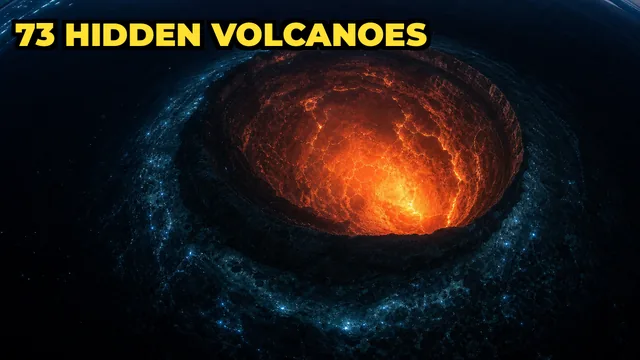 0:26
0:26