The most distant galaxy ever discovered is JADES-GS-z14-0, found by the James Webb Space Telescope and existing just 300 million years after the Big Bang. This galaxy defies our understanding of early cosmic evolution with its massive size and brightness that shouldn’t be possible so early in universal history.
The Record-Breaking Discovery
Confirmed in May 2024 using Webb’s NIRSpec instrument, JADES-GS-z14-0 shattered the previous distance record held by JADES-GS-z13-0. The galaxy exists at a redshift that places it in an era when the universe was barely out of its cosmic infancy, making it the most distant object ever spectroscopically confirmed.
The discovery represents a monumental achievement in observational astronomy, pushing the boundaries of how far back in time we can peer into cosmic history. The James Webb Space Telescope’s unprecedented infrared capabilities made this detection possible, revealing light that has traveled over 13 billion years to reach us.
An Impossibly Bright Ancient Galaxy
What makes JADES-GS-z14-0 truly extraordinary isn’t just its distance—it’s the galaxy’s shocking characteristics. Stretching over 1,600 light-years across, this cosmic giant already contained at least 500 million solar masses worth of fully formed stars when the universe was supposedly too young for such massive structures.
The galaxy’s brightness and size challenge fundamental assumptions about galaxy formation timescales. According to standard cosmological models, there simply wasn’t enough time for gravity to pull together such enormous amounts of matter and convert it into stars so early in cosmic history.
Breaking Cosmological Rules
The existence of JADES-GS-z14-0 creates serious problems for our current understanding of cosmic evolution. The standard model of cosmology suggests that early galaxies should be small, dim, and relatively primitive compared to modern galactic structures.
Instead, this ancient galaxy appears surprisingly mature and massive, indicating that either galaxy formation processes were far more efficient in the early universe than we believed, or that our models need significant revision. The discovery suggests the universe may have evolved much more rapidly in its youth than previously thought possible.
Implications for Early Universe Studies
The discovery of such a massive, bright galaxy so early in cosmic time forces astronomers to reconsider fundamental questions about structure formation. If galaxies could grow this large this quickly, it implies that the first stars and galaxies may have formed even earlier than current models predict.
This finding is part of a broader pattern of surprises from the James Webb Space Telescope, which has consistently found larger, brighter, and more mature galaxies in the early universe than theoretical predictions suggested should exist. Each discovery adds another piece to a cosmic puzzle that’s forcing scientists to rewrite textbooks about the universe’s infancy.
FREQUENTLY ASKED
How far away is JADES-GS-z14-0? ▾
JADES-GS-z14-0 exists about 13.5 billion light-years away, meaning we see it as it was just 300 million years after the Big Bang.
Why is this galaxy discovery so significant? ▾
It's the most distant galaxy ever confirmed and challenges our understanding of how quickly massive galaxies could form in the early universe.
What telescope discovered JADES-GS-z14-0? ▾
The James Webb Space Telescope discovered and confirmed this galaxy using its NIRSpec instrument in May 2024.
How big is the most distant galaxy? ▾
JADES-GS-z14-0 spans over 1,600 light-years across and contains at least 500 million solar masses of stars.
What does this discovery mean for cosmology? ▾
It suggests that galaxy formation happened much faster in the early universe than our current models predict, potentially requiring revisions to cosmic evolution theories.
Are there other ancient galaxies like JADES-GS-z14-0? ▾
The James Webb Space Telescope has found several unexpectedly large and bright early galaxies, suggesting this might be part of a broader pattern rather than an isolated case.
GO DEEPER
KEEP EXPLORING
 0:24
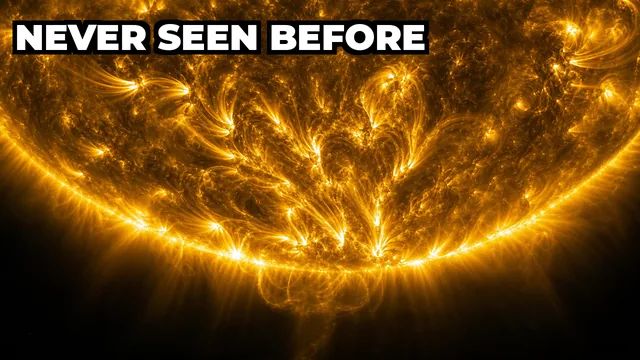
0:24We Finally Saw the Sun's Hidden Pole 🌞😱
Oct 11, 2026 0:50
0:50Webb Found Ice Clouds 12 Light-Years Away 🌌
Oct 9, 2026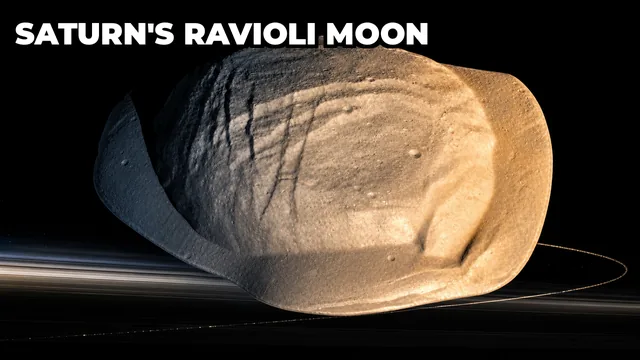 0:49
0:49Saturn Is Hiding A Moon Shaped Like Ravioli 🍝
Oct 3, 2026 0:32
0:32NASA Built It For 5 Flights. It Flew 72 On Mars 🚁
Sep 30, 2026 0:31
0:31The Cloud That Forms 52 Miles Up From Meteor Smoke ✨
Sep 30, 2026 0:16
0:16