Troll A, a concrete offshore gas platform standing 1,549 feet tall, is the tallest structure ever moved by humans — towed more than 120 miles across the North Sea from Vats, Norway, to the Troll gas field over seven days in May 1995.
How Big Is Troll A?
Troll A stands 1,549 feet from its base to the top of its derrick — taller than the Empire State Building. Its four legs are hollow concrete shafts, wide enough to contain internal stairways, pipes, and utility systems. The platform sits on the seabed in 994 feet of water, meaning more than half its total height is permanently submerged beneath the surface of the North Sea.
When fully ballasted with seawater, Troll A weighs approximately 1.2 million tons. That figure is not incidental — it is the entire engineering philosophy of the structure.
Why Does Troll A Weigh Over a Million Tons?
Troll A is what engineers call a gravity-base structure. Rather than being anchored to the seabed with steel piles driven deep into the rock, it is held in place entirely by its own mass. The platform’s colossal weight, combined with concrete skirts that press roughly 120 feet down into the soft clay of the seabed, keeps it stationary through some of the harshest storm conditions on the planet — without a single anchor.
This design choice was deliberate. Norway selected a concrete gravity base for several practical reasons: the entire structure, including its topside deck, could be assembled in the calm waters of a sheltered Norwegian fjord, then floated out to sea as a finished unit. No deep-water pile-driving. No piecemeal assembly offshore. The fjord acted as a drydock for one of the most complex objects ever built.
How Was Troll A Moved?
Moving Troll A required ten of the world’s largest ocean-going tugboats. Eight pulled from the front in a coordinated spread formation; two operated from behind to steer. The convoy moved at a slow, deliberate pace — the entire 120-mile journey from Vats to the Troll field took seven days in May 1995.
Once the platform reached its target position over the gas field, the process reversed: seawater was pumped into the ballast chambers, and Troll A sank — by design — settling its concrete skirts into the seabed clay. The weight that made it so difficult to move now made it immovable.
Where Is Troll A Today?
Troll A is still operational. It sits above the Troll gas field in the Norwegian sector of the North Sea, a field estimated to hold roughly 40 percent of Norway’s remaining natural gas reserves. The platform has been producing gas since 1996 and is expected to continue well into the second half of the 21st century.
The scale of Troll A is difficult to overstate. It is not the largest offshore platform by deck area, nor the most expensive ever built — but no structure of comparable height has ever been constructed, transported, and installed in a single piece, before or since. The move that took ten tugboats and a week of open-ocean towing remains, nearly three decades later, an unbroken record in the history of human engineering.
FREQUENTLY ASKED
How tall is the Troll A platform? ▾
Troll A stands 1,549 feet tall from its base to the top of its derrick, making it taller than the Empire State Building and the tallest structure ever moved by humans.
How does Troll A stay in place without anchors? ▾
Troll A is a gravity-base structure — its weight of over 1.2 million tons when ballasted with seawater, combined with concrete skirts driven about 120 feet into the seabed clay, holds it firmly in place without anchors or piles.
How was the Troll A platform transported to the North Sea? ▾
Ten of the world's largest tugboats — eight pulling from the front and two steering from behind — towed Troll A more than 120 miles from Vats, Norway, to the Troll gas field over seven days in May 1995.
How deep is the water where Troll A is installed? ▾
Troll A's legs stand in 994 feet of water on the North Sea seabed, meaning more than half the platform's total height is below the ocean surface.
Why was concrete used to build Troll A instead of steel? ▾
A concrete gravity-base design allowed Troll A to be fully assembled — deck included — in a sheltered Norwegian fjord and floated out as a single finished unit, eliminating the need for deep-water pile-driving or offshore assembly.
Is the Troll A platform still producing gas? ▾
Yes, Troll A has been producing gas since 1996 and remains operational today, sitting above a field that holds roughly 40 percent of Norway's remaining natural gas reserves.
KEEP EXPLORING
 0:04
They Read a 3,800-Year-Old Letter Sealed Shut 📜
Oct 12, 2026 0:32
NASA Built It For 5 Flights. It Flew 72 On Mars 🚁
Sep 30, 2026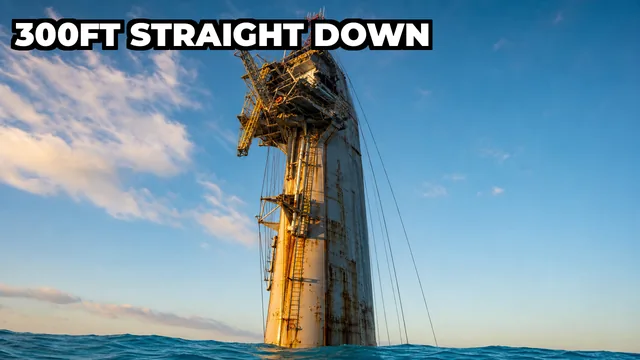 0:39
The Ship That Flips 90° In Under 30 Minutes 🌊
Sep 20, 2026 0:27
AI Cracked a Math Problem Humans Couldn't in 80 Years 🤯
Sep 13, 2026 0:36
Fired Casings Still Hold A Fingerprint 🔬
Sep 11, 2026 0:35