What Ancient Temple Was Just Discovered 700 Feet Below Lake Titicaca?
May 24, 2026
A 1,000-year-old pre-Inca temple built by the Tiwanaku civilization was discovered in 2024, sitting 700 feet below the surface of Lake Titicaca with ceremonial offerings still perfectly preserved in their original positions.
The Sacred Lake’s Hidden Secret
Lake Titicaca, straddling the border between Peru and Bolivia at over 12,500 feet above sea level, has long been revered as sacred by indigenous cultures. This massive body of water holds the distinction of being the highest commercially navigable lake on Earth, but its true treasures lay hidden beneath the surface for a millennium.
The discovery occurred near Khoa Reef, an area already considered sacred in Inca mythology as the birthplace of Inti, the Sun God, on the nearby Isla del Sol. Using advanced sonar technology in 2024, researchers detected what appeared to be a structured, terraced platform resting on the lake floor.
The Tiwanaku Civilization’s Final Message
The temple belongs to the Tiwanaku civilization, a sophisticated pre-Inca culture that dominated the region around Lake Titicaca from approximately 300 to 1000 CE. This discovery may represent one of their final ceremonial acts before the civilization’s mysterious collapse around 1000 CE.
What makes this find extraordinary is not just its age, but its pristine condition. Ceramic vessels and stone offerings remain exactly where they were placed by Tiwanaku priests over 1,000 years ago. No currents disturbed them, no looters found them, and no natural disasters moved them from their sacred positions.
Perfect Preservation Conditions
The remarkable state of preservation owes itself to Lake Titicaca’s unique environmental conditions. The lake’s cold waters, maintaining temperatures between 50-57°F (10-14°C) year-round, create an ideal preservation environment at depth. The high altitude and resulting atmospheric conditions further contribute to the site’s protection from decay and disturbance.
This natural refrigeration effect, combined with the lake’s relative isolation from major currents at such depths, essentially froze this moment in time. The ceramic vessels and ritual objects appear much as they would have when first placed by Tiwanaku religious practitioners.
Archaeological Significance
The discovery provides unprecedented insight into Tiwanaku religious practices and their relationship with Lake Titicaca. The careful placement of offerings suggests this was a significant ceremonial site, possibly used for rituals related to water worship or communication with deities.
For archaeologists, finding undisturbed ritual contexts is extraordinarily rare. Most ancient sites have been looted, damaged by natural forces, or altered by subsequent cultures. This underwater temple represents a time capsule of Tiwanaku spiritual life, offering researchers the opportunity to study an intact ceremonial setting.
Modern Technology Meets Ancient Mystery
The use of sonar technology to locate this temple demonstrates how modern archaeological methods continue to reveal secrets of the past. The precise mapping capabilities of contemporary sonar systems allowed researchers to identify structural anomalies on the lake floor that would have been impossible to detect using traditional survey methods.
This discovery suggests that Lake Titicaca may hold many more archaeological treasures. If one temple survived intact for 1,000 years, others likely remain hidden in the lake’s depths, waiting for technology and exploration to bring their stories to light.
The temple near Khoa Reef stands as a testament to the sophisticated engineering and spiritual practices of the Tiwanaku people, preserved in one of Earth’s most remarkable natural laboratories.
FREQUENTLY ASKED
How old is the temple discovered in Lake Titicaca? ▾
The temple is approximately 1,000 years old, dating to around 1000 CE when the Tiwanaku civilization collapsed.
Why were the artifacts so well preserved underwater? ▾
Lake Titicaca's cold water temperatures (50-57°F year-round) and high altitude created perfect preservation conditions that prevented decay and disturbance.
What civilization built the underwater temple in Lake Titicaca? ▾
The Tiwanaku civilization, a sophisticated pre-Inca culture that dominated the Lake Titicaca region from approximately 300 to 1000 CE.
Where exactly in Lake Titicaca was the ancient temple found? ▾
The temple was discovered near Khoa Reef, an area already considered sacred in Inca mythology as the birthplace of Inti, the Sun God, on the nearby Isla del Sol.
How was the underwater temple discovered? ▾
Researchers used advanced sonar technology in 2024 to detect what appeared to be a structured, terraced platform resting on the lake floor.
How deep is Lake Titicaca where the temple was found? ▾
The temple was found sitting 700 feet below the surface of Lake Titicaca.
GO DEEPER
KEEP EXPLORING
 0:42
0:42They Paved a Roman Road With a 7ft Ancient Statue 🏛️
Oct 6, 2026 0:49
0:49This Iron Pillar Refused To Rust For 1,600 Years ⚙️
Oct 5, 2026 0:52
0:52A 160-Ton Obelisk Flew Home After 68 Years ✈️
Oct 4, 2026 0:19
0:19They Built A 41ft Ring From 60 Mammoths 🦣
Oct 3, 2026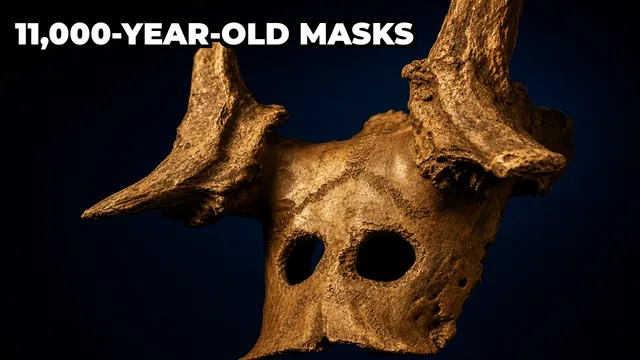 0:05
0:0533 Deer Skull Masks — 11,000 Years Old 🦌😱
Oct 2, 2026 0:34
0:34