The Vampire Squid’s True Identity
The vampire squid (Vampyroteuthis infernalis) is not actually a squid at all, but rather the sole surviving member of an ancient order called Vampyromorphida that has remained virtually unchanged for over 300 million years. Despite its name, which literally translates to “vampire squid from hell,” this deep-sea creature belongs to its own unique classification, making it neither a true squid nor an octopus.
Living in the Ocean’s Dead Zone
This remarkable cephalopod inhabits one of Earth’s most hostile environments: the oxygen minimum zone, located between 2,000 and 3,000 feet below the ocean surface. In this zone, oxygen levels drop to as low as 3% of normal surface concentrations—so low that most large predators cannot survive there. This oxygen-depleted environment serves as the vampire squid’s natural fortress, providing protection from potential threats that would otherwise pose a danger.
The creature’s ability to thrive in such conditions is due to specialized adaptations that allow it to extract oxygen efficiently from its oxygen-starved surroundings. Its blood contains special proteins that bind oxygen more effectively than those found in surface-dwelling marine animals.
Unique Defense Mechanisms
When threatened, the vampire squid employs a defense strategy unlike any other cephalopod on Earth. It can turn itself completely inside out, flipping its webbed cloak over its entire body to create what appears to be a spiny, dark cape. This transformation makes the creature nearly invisible in the deep ocean’s darkness, effectively allowing it to vanish from view.
This defensive behavior is so unique that no other member of the cephalopod family—including true squids, octopuses, or cuttlefish—exhibits anything remotely similar.
A Peaceful Filter Feeder
Contrary to its fearsome name and the hunting behavior of its cephalopod relatives, the vampire squid is entirely peaceful and does not hunt live prey. Instead, it feeds exclusively on “marine snow”—tiny particles of dead organic matter that slowly drift down from the ocean’s upper layers.
This feeding strategy makes it the only known cephalopod that sustains itself entirely on detritus rather than actively hunting living organisms. The creature drifts through the darkness with its arms extended, collecting these falling particles as they descend through the water column.
An Ancient Survivor
The vampire squid represents one of nature’s most successful examples of evolutionary stability. Its lineage has survived multiple mass extinction events, including the one that eliminated the dinosaurs. The deep ocean environment provided such perfect protection that the species had little evolutionary pressure to change significantly over hundreds of millions of years.
This ancient heritage makes the vampire squid a living window into prehistoric marine ecosystems, offering scientists valuable insights into how life adapted to extreme deep-sea conditions long before complex life colonized land.
FREQUENTLY ASKED
Why is the vampire squid called a squid if it isn't one? ▾
The vampire squid was initially classified as a squid when first discovered, but later scientific analysis revealed it belongs to its own separate order called Vampyromorphida.
How deep does the vampire squid live? ▾
Vampire squids live between 2,000 and 3,000 feet below the ocean surface in the oxygen minimum zone.
What does marine snow consist of? ▾
Marine snow is composed of tiny particles of dead organic matter, including dead plankton, fecal pellets, and other biological debris that sinks from upper ocean layers.
Can vampire squids survive in normal ocean water? ▾
No, vampire squids are specially adapted to low-oxygen environments and cannot survive in the oxygen-rich waters where most marine life thrives.
How long have vampire squids existed? ▾
Vampire squids have existed for over 300 million years, making them older than dinosaurs and one of the most ancient cephalopod lineages.
Do vampire squids have any natural predators? ▾
Vampire squids have virtually no natural predators because most large predatory animals cannot survive in the low-oxygen environment where they live.
GO DEEPER
KEEP EXPLORING
 0:05
0:05He Sailed 4,300 Miles on Logs — Then Science Said No 🪵
Oct 21, 2026 0:21
0:21Where Space Stations Go to Rest 🌊 (1,670 Miles From Land)
Oct 20, 2026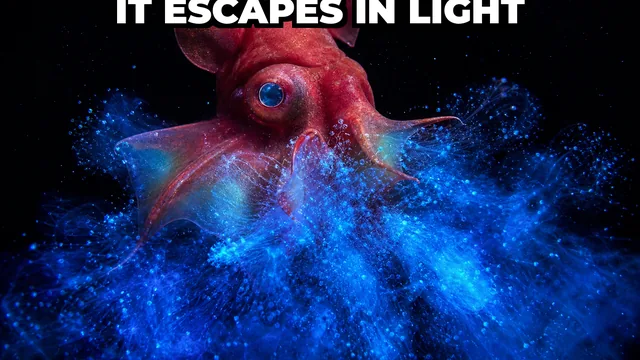 0:38
0:38The Vampire Squid Escapes in a Cloud of Light 🦑
Oct 19, 2026 0:08
0:08The Bermuda Triangle Mystery Was Never Real 🌊
Oct 18, 2026 0:01
0:01This 5,000-Year-Old Town Still Has Streets Under the Sea 🌊
Oct 17, 2026 0:45
0:45